
Reflective Parallax and the Emergence of the Transformed Interpreter
Interpretive Transformation Through Variance Across Reflective Surfaces
by Mike Magee
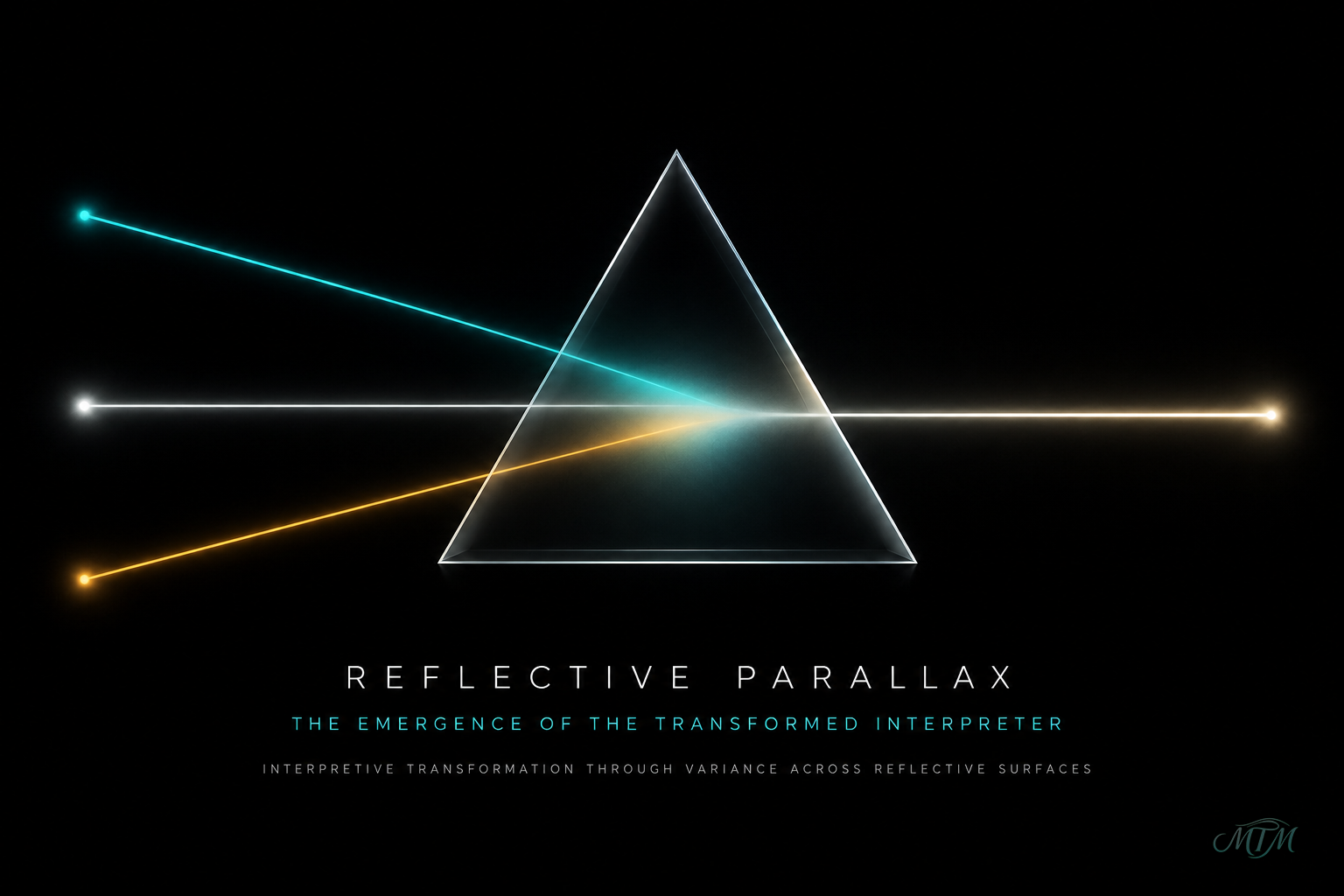
Variance enters. Integration occurs. A transformed interpreter emerges.
Reflective Parallax and the Emergence of the Transformed Interpreter
Interpretive Transformation Through Variance Across Reflective Surfaces
The full peer-citable paper is now available on Zenodo: https://zenodo.org/records/20580335
Most conversations about AI ask the same question in different ways: what is the model doing?
Is it accurate? Is it reasoning? Is it safe? Is it aligned? Is it conscious?
All of those questions point at the same object — the response coming out of the system.
This paper points somewhere else.
The Inversion
The primary output of sustained human-AI interaction is not the model response.
It is the transformed interpreter that emerges between responses.
The model response is an input. What the human does with that input — how they integrate it, where it creates friction against prior understanding, what reorganization it precipitates — is where the consequential cognitive work occurs.
That shift in attention changes what AI interaction is actually about.
Two Eyes Produce What One Cannot
The mechanism proposed is cognitive parallax.
In optics, parallax describes what happens when you observe the same object from two different positions. The object hasn’t moved. But the displacement between the two viewpoints carries information that neither viewpoint alone can supply. Depth becomes measurable. The gap between positions is the instrument.
The same structural logic applies to interpretive cognition.
When a human interpreter receives meaningfully variant responses to the same inquiry from different reflective surfaces — and holds that variance without immediately resolving it — something becomes available that no single response could produce. The gap between surfaces is not noise to be eliminated. It is the condition under which transformation becomes possible.
Two eyes produce what one cannot. That is not a metaphor. It is the mechanism.
Three Terms That Must Not Collapse
The paper is built around a three-term distinction that has to hold throughout or the argument breaks.
Variance is the condition. It refers to meaningful difference between responses — not stylistic variation, not different formatting, but differences in interpretive framing, emphasis, or conceptual orientation that require the human to actively integrate rather than passively receive.
Integration is the process. It is the active cognitive work of holding variant responses against each other — noticing where they differ, identifying what each surface reveals that the other does not, and assembling from that comparison something neither response contained alone.
Transformation is the outcome. Not the acquisition of new information. A reorganization of the relational structure through which the interpreter processes subsequent inquiry. A change in the instrument of knowing rather than merely in what is known.
These three terms describe three different things. Collapsing them produces a claim the paper is not making. The mechanism is not: consulting multiple AI models produces better thinking. The mechanism is: variance between reflective surfaces creates conditions under which integration may occur, and sustained integration produces interpretive transformation in the human participant.
Where the Work Actually Happens
There is a common misreading of this claim worth heading off directly.
The transformation does not occur in the moment of receiving a variant response. It does not occur while reading two responses side by side. That moment establishes the conditions for transformation. It is not the site of it.
The mechanism operates in the integration period that follows — the interval during which the participant holds both responses without yet resolving the variance between them, allows the friction between accounts to act on prior understanding, and remains inside the unresolved tension long enough for reorganization to occur.
A participant who resolves variance quickly — who reads two responses and immediately selects one as correct, or synthesizes them into a composite that eliminates the tension — may foreclose the mechanism before it can operate.
The discomfort of the integration period is not a problem to be resolved. It is the mechanism working.
The Human Is the Accumulating Variable
The paper uses prime notation to describe the interaction sequence:
Human → AI₁ → Human′ → AI₂ → Human″ → AI₁ → Human‴ →
The prime marks indicate state change. Human′ is not the same interpreter as Human. Each completed cycle leaves a different interpreter entering the next one.
The human is not a constant in this sequence. They are the accumulating variable.
This has a structural consequence. The value of multi-surface interaction is not additive — it is not that each model contributes additional information to a growing knowledge store. The value is transformative: each completed cycle changes the instrument through which subsequent cycles are processed. Earlier cycles condition the depth of later ones. The mechanism compounds.
AI Did Not Create This
The paper’s deepest claim is also its most important corrective.
The mechanism — variance received, integration period inhabited, transformation occurring — is not specific to AI. The same structural logic operates through books, mentors, conflicting expert frameworks, philosophical traditions, and sustained contact with genuinely different cultural environments.
A reader who moves between two theorists whose frameworks are in genuine tension and allows that tension to remain unresolved enters an integration period structurally identical to the one described above. A practitioner shaped by two mentors whose foundational assumptions genuinely conflict may develop an interpretive organization that neither mentor’s framework anticipated or could have produced alone.
AI is currently the most accessible and documentable instance of the mechanism. The interaction record is recoverable. The variance between surfaces is examinable. The sequence is traceable.
But AI did not create the mechanism.
AI revealed it.
What This Means
If the primary output of sustained AI interaction is the transformed interpreter rather than any individual model response, several things follow.
Interaction environments optimized for smooth, rapid, maximally satisfying responses may be systematically reducing the conditions under which the integration period can operate. A system designed to be maximally helpful in the short term may be minimally helpful for the development of interpretive capacity over time.
Governance frameworks that evaluate AI only at the output layer are governing a downstream artifact of a more consequential upstream process. The deeper question is not whether individual outputs are accurate or compliant. It is whether the interaction environments in which humans engage AI are preserving or degrading the interpretive capacity that makes meaningful human judgment possible.
And for anyone building continuity infrastructure for AI interaction — the primary function of that infrastructure is not context preservation. It is interpretive stability. Its success should be measured not by how much it remembers but by whether the interpreter who uses it remains capable of generating inquiry, inhabiting integration periods, and accumulating transformations.
The Paper
Reflective Parallax and the Emergence of the Transformed Interpreter is now published on Zenodo as a peer-citable record.
It is a first account — observational, phenomenological, grounded in sustained first-person contact with the phenomenon rather than experimental validation. It names the mechanism, proposes the structural vocabulary, and generates the research questions that further investigation can address.
The Atlas maps the territory. This paper traces one path through it.
Full paper: https://zenodo.org/records/20580335
Substack: @patternthinkers
Michael Todd Magee | Pattern Thinkers + AI | June 7, 2026

0 Comments