
The AI Gatekeeper Problem
Inside The Hiring System – A Four-Part Series
by Mike Magee
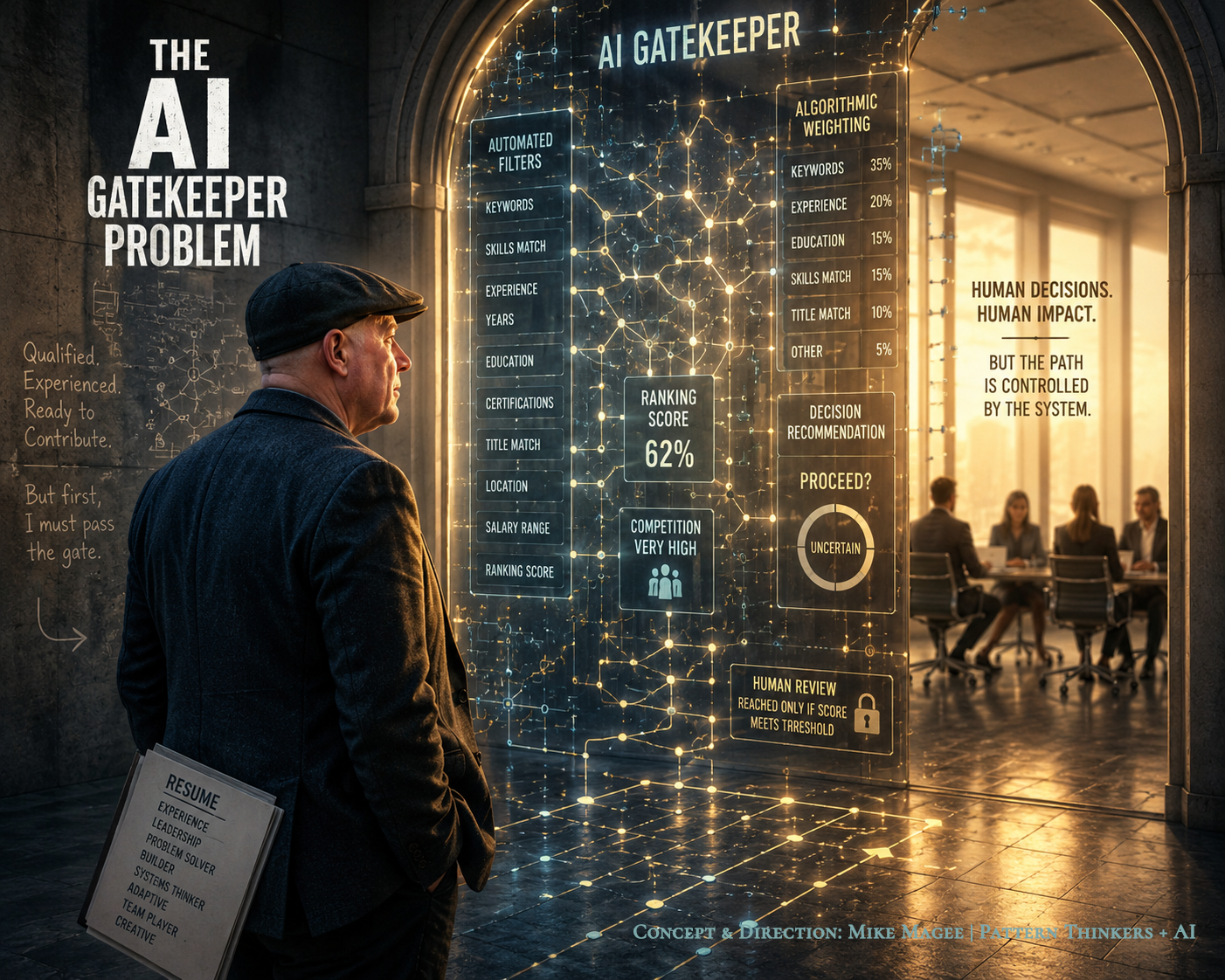
The modern hiring process increasingly evaluates candidates before a human ever reviews their application
Article 1 — A 4-Part Series: The AI Gatekeeper Problem
Inside the Hiring System — A Framework Reflection
A friend told me recently to stop using AI to help write my resume.
The reasoning was straightforward: many hiring managers claim they reject AI-generated resumes. If a resume reads like it was assembled by a language model rather than lived by a human being, questions naturally follow about authenticity, communication, and whether the candidate can accurately represent themselves.
The advice sounds reasonable.
The problem is that it assumes the resume reaches a human being.
It often does not.
Before a hiring manager reads a single word of most job applications, that application passes through an Applicant Tracking System. ATS platforms are the intake architecture of modern recruiting — software designed to receive, score, rank, and filter applications at a scale no human team could manage manually.
The mechanics vary by platform, but the general logic is consistent. The system scans for keyword alignment between the application and the job description. It evaluates formatting compatibility. It scores candidates against a target profile and ranks them accordingly. Applications that fall below a threshold may never surface to a human reviewer at all.
This is not a secret. ATS platforms have existed for decades. Their use has expanded steadily as application volumes have grown. The business case is straightforward — large organizations receive thousands of applications for competitive roles, and human review of every submission is not operationally viable.
The problem is not that ATS systems exist.
The problem is what happens when the stated preferences of human hiring managers and the operational logic of algorithmic filtering point in opposite directions.
A hiring manager who rejects AI-generated content is expressing a preference that operates downstream of the filter. The ATS has already made its evaluation before that preference gets to function. And the ATS, by design, is pattern-matching at scale — which means it is doing something structurally similar to what a language model does when it optimizes a resume for keyword density.
The system that screens for inauthenticity is itself a pattern-matching engine evaluating surface signals.
That is not irony in the casual sense. It is a feedback loop that cannot close because the two ends of it never actually meet.
The practical consequence for applicants is a strategic trap with no clean exit.
Write a resume optimized for human readers — clear, authentic, narrative, human in voice — and risk elimination before a human ever sees it because the keyword density is insufficient or the formatting doesn’t parse correctly through the ATS.
Write a resume optimized for ATS systems — keyword-rich, structured to parse cleanly, aligned to the exact language of the job description — and risk rejection by the human reviewer who receives it as evidence of inauthenticity or algorithmic generation.
Both failure modes are real.
Both are structural.
Neither is the applicant’s fault in any meaningful sense.
And the advice ecosystem — career coaches, LinkedIn influencers, resume writers, HR professionals — tends to optimize for one end of this without fully accounting for the other.
“Be authentic” is good advice for the human review stage.
It does not help you reach the human review stage.
There is a second layer worth naming.
ATS systems are not neutral filters. They are trained on historical data, configured by recruiters, and tuned to the language of specific job descriptions. This means they systematically advantage candidates who have worked in environments that use the same vocabulary as the hiring organization.
Someone who performed identical functions under different terminology — because they worked in a different industry, a different company culture, or a different era of professional language — may score significantly lower than a candidate with shallower actual experience who happens to use the expected words.
The filter is not measuring capability.
It is measuring linguistic alignment with a target profile.
Those are related but not equivalent, and the gap between them is where qualified candidates disappear.
This is particularly consequential for people transitioning between industries, people returning to the workforce after a gap, people who built expertise through non-traditional pathways, and people whose cognitive or communication styles produce resumes that don’t conform to expected structural conventions.
The ATS does not know the difference between a candidate who cannot do the job and a candidate who did the job under a different name.
None of this is a conspiracy.
The organizations using these systems are not attempting to harm applicants. They are attempting to manage an operationally impossible volume problem using the tools available to them.
But intention does not determine outcome.
A system optimized for scale will produce scale-optimized outcomes.
Whether those outcomes align with the actual goal — identifying the most qualified candidates — is a separate question that the system itself is not designed to answer.
The hiring architecture was built to process volume.
It was not built to find the person.
Those are different problems.
And for as long as they are treated as the same problem, the filter will keep doing exactly what it was designed to do — which is not the same as what the organization actually needs it to do.
I have been inside this system for four months. Thirty-one applications across a deliberate range of roles.
The pattern I have observed is not that the system is broken in an obvious way.
It is that the system is functioning correctly according to its design — and the design does not fully account for the human being on the other end of it.
That distinction matters.
Because systems that are broken can be fixed once the break is identified.
Systems that are working exactly as designed require a different kind of conversation entirely.
This article is part of a four-part series examining modern hiring as a system:
- The AI Gatekeeper Problem
- The Social Capital Lottery
- The Invisible Qualification
- Four Months Inside the System
Next in the series:
The Social Capital Lottery — why the relationship network has always been the real hiring pipeline, and what job boards actually sell.

0 Comments