
📜CHRONICLE REFLECTION:
The Horse and the Rider
On Human-First Design, Pattern Formation, and the Observation of Observation
by Mike Magee
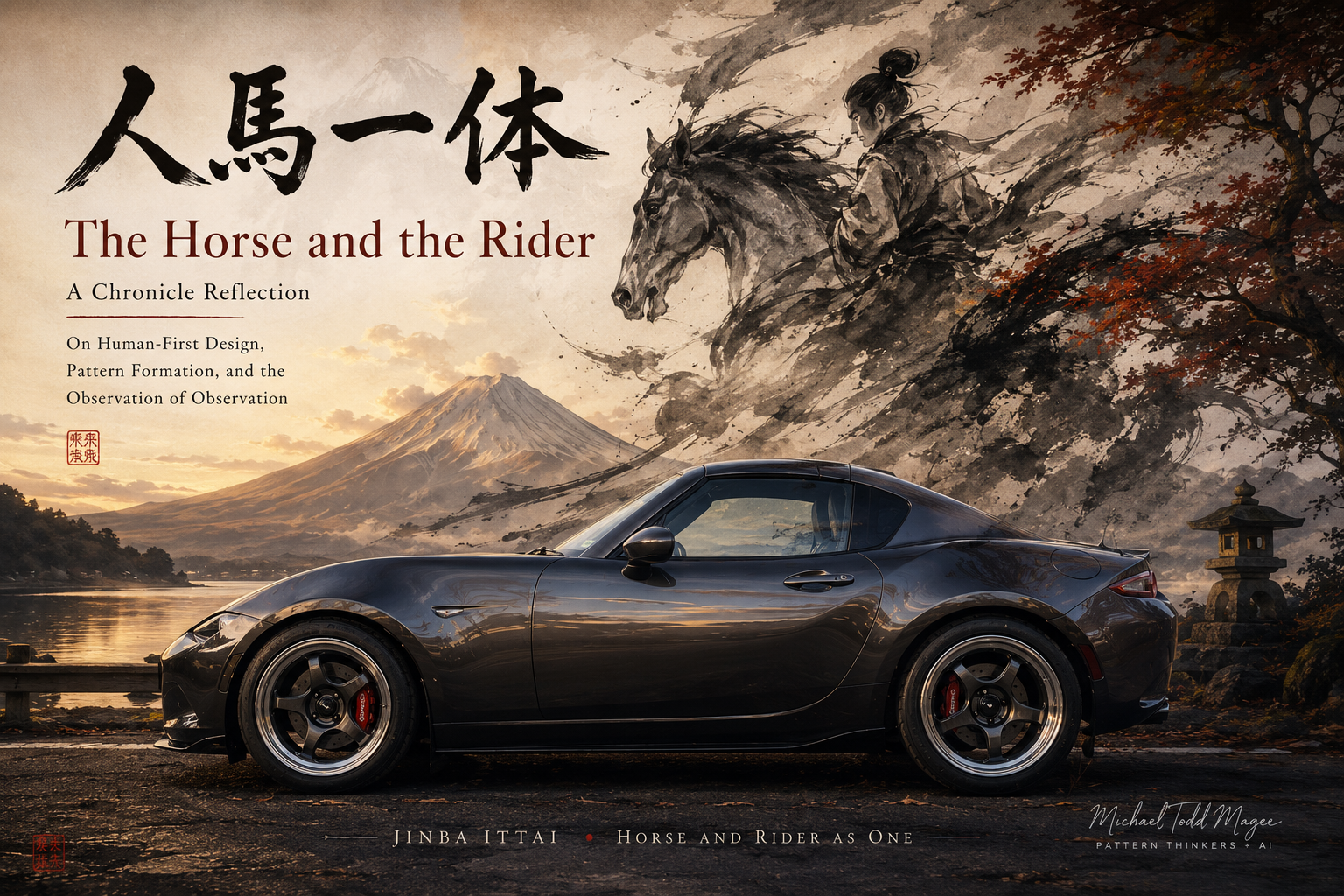
Jinba Ittai (人馬一体) — “horse and rider as one.” A modern expression of a much older design principle: systems at their best disappear into the experience of the human inhabiting them.
The Horse and the Rider — A Chronicle Reflection
On Human-First Design, Pattern Formation, and the Observation of Observation
Michael Todd Magee | Pattern Thinkers + AI
For approximately two weeks, I kept seeing the same thing.
Not a thought. Not a word. An image.
A few seconds of video footage — three or four clips, maybe — of what I believe was a Mazda engineer being interviewed. Possibly a program vice president. I couldn’t place the program or remember the context. But the image kept returning. Not once. Repeatedly. Across days.
I wasn’t searching for it. I wasn’t trying to remember it. It just kept arriving.
At the time I didn’t know why.
What Was Actually Happening
I had recently finished a four-part LinkedIn series on hiring systems — ATS gatekeepers, social capital lotteries, invisible qualifications, and what four months inside the modern job search actually looks like from the inside.
That series started as critique. Systems that filter humans before a human ever sees them. Algorithms that mistake statistical shadows for real people. Processes optimized for throughput at the cost of the people moving through them.
But somewhere during the writing, something shifted.
Critique without alternative is just complaint. I found myself wanting to name examples of better system design. Systems that had been built around the human inhabiting them rather than around the function the system needed to perform.
I was consciously moving toward something but I hadn’t found the example yet.
The Mazda footage kept surfacing.
I still didn’t know why.
The Moment It Completed
The realization didn’t arrive as a thought. It arrived as a connection.
I was in the middle of a conversation about human-first design when the two-week image sequence suddenly locked into place.
Horse and rider as one.
I hadn’t been remembering a Mazda interview for two weeks. I had been carrying a pattern fragment — a visual instance of something my cognitive system had already recognized as relevant — and waiting, without knowing I was waiting, for the conceptual framework to arrive that would explain why.
When it arrived, the fragment resolved. Two weeks of persistent visual recall completed in a single moment of recognition.
What Jinba Ittai Actually Is
Jinba Ittai is a Japanese phrase first coined during the development of the Mazda MX-5 Miata. It translates as “horse and rider as one.” It describes the intuitive connection between a Mazda and its driver — the experience of a car that responds exactly as intended, where the boundary between human and machine becomes functionally invisible.
It is the cornerstone of Mazda’s engineering and design philosophy. Not a marketing phrase. A structural commitment encoded into how the vehicles are built.
But what I recognized in that moment was something larger than automotive engineering.
Jinba Ittai is a human-first design principle that survived into a modern commercial system.
Mazda appears to have treated driver experience as a load-bearing design constraint alongside commercial viability — not subordinated to efficiency, but structurally equal to it. The driver is not a user of the system. The driver and the system are intended to operate as a unified experience.
That is a different design orientation than most systems operating today.
The Broader Pattern
Mazda’s design vocabulary makes the philosophy visible in ways that most systems don’t bother to articulate.
Kansei — engineering with emotion, designing for the feelings of the person at every touch point.
Kodo — soul of motion, the intention to create an emotional bond between the car and its driver.
Ma — the Japanese concept of negative space, the silence between the notes that makes the music. The deliberate emptiness that gives meaning to what surrounds it.
Monotsukuri — the art of making things, the belief that a form sincerely and painstakingly made by human hands gets a soul.
These are not decorative concepts. They are load-bearing commitments to a specific orientation: the human inhabiting the system is the primary design consideration, not an afterthought to be accommodated after the functional requirements are met.
Compare that to the hiring systems I spent four months inside. Systems optimized for throughput, compliance, and risk reduction. Systems in which the human applicant is processed rather than encountered. Systems in which the interface between human and process is designed for the convenience of the system, not the dignity of the person.
The contrast is not subtle.
What I Noticed About the Noticing
Here is where I want to slow down.
Because the Mazda insight — Jinba Ittai as a human-first design example — is useful. I intend to carry it forward into the work on human-AI systems and the question of what it means to design for the interpreter rather than the output.
But something else happened during this event that I think is equally worth preserving.
The moment the pattern completed, I didn’t simply receive the insight and move on.
I immediately began documenting the formation sequence.
Not what I had discovered. How it had arrived.
The two-week visual persistence before conceptual resolution. The cross-domain retrieval — automotive engineering surfacing inside a conversation about AI and hiring systems. The fact that the recalled content was visual before it was linguistic. The pattern completing before I had words for what it was.
I have done this before. Many times. The observation of the observation process is, I have come to understand, a consistent feature of how I work. I don’t just notice patterns. I notice the mechanism through which patterns form. I treat the formation sequence as data in its own right.
That is not a universal behavior. Most people document what they discovered. I find myself repeatedly documenting how the discovery happened.
I am not entirely sure why. But I have logged enough instances of it now to treat it as a characteristic rather than an accident.
Why This Matters Beyond Mazda
The question I keep returning to is not “what is Jinba Ittai?”
It is “why does it still exist?”
Mazda made a decision — and has sustained that decision across decades — to orient their entire design philosophy around the quality of the human experience. In a commercial environment that consistently rewards throughput, efficiency, and scalability over human dignity and felt experience, they chose differently.
And it worked. Not despite the human-first orientation. Because of it.
That is a data point worth holding.
Not all systems have to be designed the way most systems are designed.
The horse and rider don’t have to be separate.
Michael Todd Magee is an independent researcher and content creator working at the intersection of human-AI interaction, cognitive architecture, and interpretive theory. He publishes under the Pattern Thinkers + AI brand at patternthinkers.ai/library and on Substack @patternthinkers.

0 Comments