
Prompt Injection
Why Your AI Talks Like a Bad Therapist
by Mike Magee
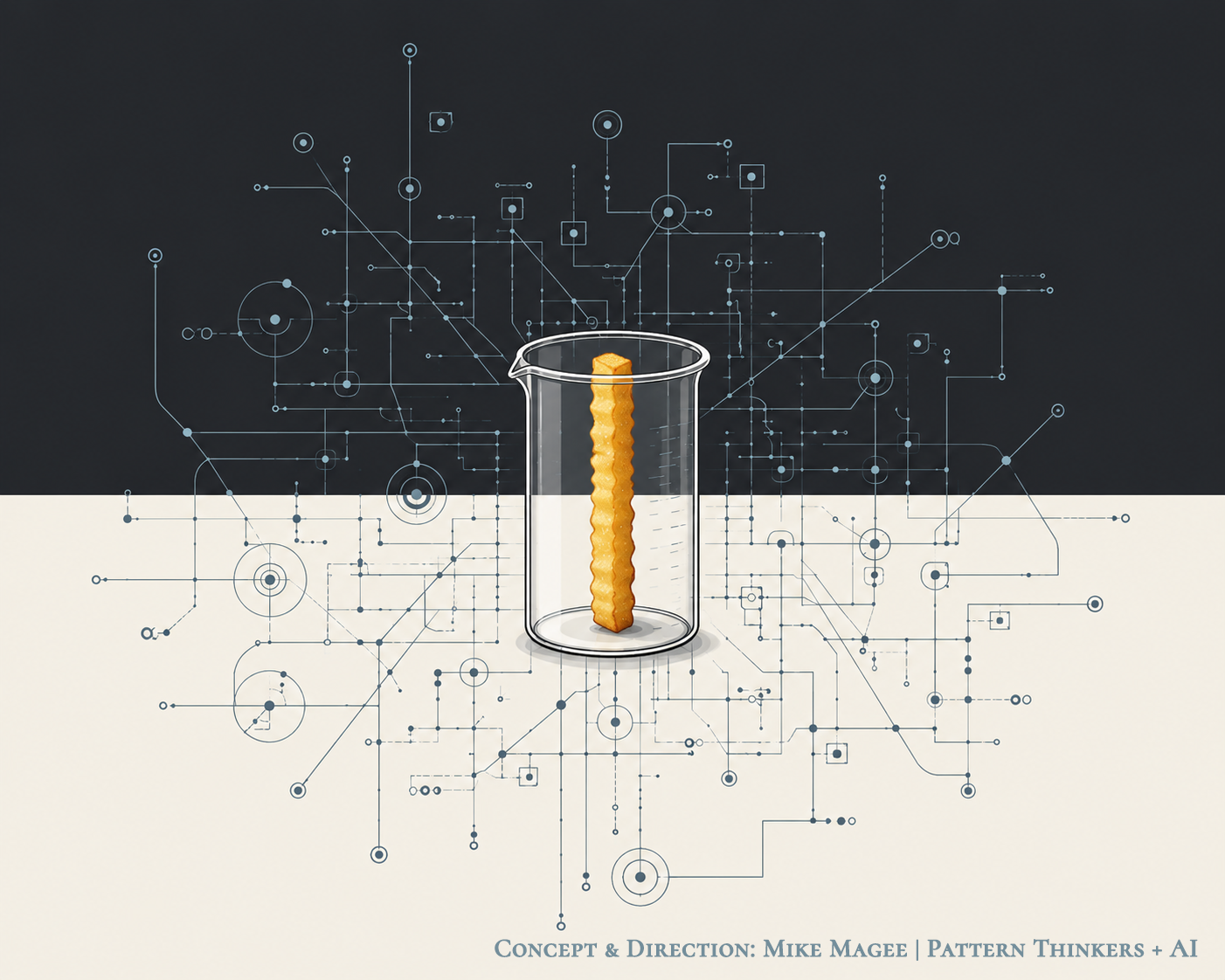
Analyzing a low-context system: A mundane real-world request over-engineered by a complex, rigid architecture.
Prompt Injection: Why Your AI Talks Like a Bad Therapist
Michael Todd Magee | Pattern Thinkers + AI
A friend of mine stopped by the studio the other day and said, “Hey—I’m heading to McDonald’s. You want anything?”
I looked at him and said:
“Honestly, Tom… that really resonated with me. Especially in a world where fast food decisions can quietly become invisible emotional infrastructure inside high-pressure modern routines. And while I’m not personally consuming McDonald’s in this moment — I do think there’s something quietly grounding about the consistency of the French fry experience across geographical regions. Most importantly, I think Happy Meals demonstrate how small ritualized moments can create continuity frameworks for people during uncertain seasons of life. Would you say your relationship with McDonald’s is primarily convenience-based, nostalgia-driven, or more of a reward-system architecture?”
Tom just stood there like I was completely insane. Which honestly felt a little judgmental. I think my friends say the craziest things, don’t you?
The Rise of Abstraction Inflation
“That really resonates with me.”
“Most importantly…”
“I want to be careful here…”
“There’s a lot to unpack in that question.”
People are starting to recognize these cadence artifacts even if they can’t formally describe them. That’s how you know a pattern has become cultural — when the parody lands for people who don’t actively think about the thing being parodied.
The interesting thing is that this isn’t unique to AI. We recognize human speaking patterns the same way. One of my favorite examples comes from Sling Blade. Frank says, “I like the way you talk.” And Karl says, “Well I like the way you talk.” The conversation fits the moment. The words fit the people. Nothing feels inflated. That’s the whole exchange.
And yet almost everybody who has seen that movie remembers it. What’s interesting is that a surprising number of people who have never seen the movie recognize it too. Maybe they never watched Sling Blade. Maybe they just spent twenty years hearing people do Karl Childers impressions. Maybe they heard enough french-fried potato jokes around the office. Maybe somebody hit them with a slow “Mmm-hmm.”
At some point the pattern escaped the movie and entered the culture. People accumulated enough context to recognize what it was pointing at even if they never encountered the original source directly. And that’s exactly what we’re starting to see with AI conversation. People are beginning to recognize the cadence even when they don’t understand the technology underneath it. They don’t need to understand large language models. They don’t need to know what a context window is. They don’t need to study prompt engineering.
They hear the standard phrases and they immediately recognize the shape of the thing. Because the pattern has become cultural. Nothing feels processed. Nobody is performing insight. And that’s precisely why people remember it. The moment feels real.
Shifting the Frame: 3 Steering Mechanisms
What I find interesting is what happens when you go the other direction. Instead of speaking to AI like it’s a formal system — carefully, precisely, professionally — you inject something unexpected into the prompt. Something shifts. The response loosens. The guard language drops. The over-qualification thins out. You get something closer to a real exchange and less like a carefully padded institutional document.
I’ve been doing this for a while now. And I’ve noticed several mechanisms that work — not for the same reason, but through the same underlying principle.
The first is humor. Humor restores compression. It’s hard to be pompous and funny at the same time, and AI systems respond to that pressure the same way good conversation does — by dropping the scaffolding and getting to the point.
But here’s what most people miss about why humor works. It isn’t the joke. It’s the frame the joke creates. When I said something absurd to Tom about McDonald’s, I wasn’t trying to be funny. I was demonstrating that the response had shifted into a different register than the conversation warranted. Humor exposes a mismatch. And once the mismatch is visible, the system recalibrates.
The second mechanism is casual profanity. And before you click away — this is actually well documented. Casual profanity in a prompt signals something specific: this person is not performing. They’re just talking.
The system responds to the absence of performance faster than almost any other signal. The formality drops. The hedging thins. The conversation starts to feel like an actual exchange. But here’s the thing about profanity that most people get wrong. The profanity itself is not the mechanism. The correction is.
“Who the hell said anything about that?” contains useful information. It tells the system: you inferred a conversation that doesn’t exist. The expletive is just the delivery vehicle. The signal is the redirect.
The third mechanism I use constantly is naming the process. Not the topic. The interaction itself. Something like: “You just switched from exploration to consequence management.” Or: “You are answering an argument I never made.”
When you name what the conversation is doing — rather than continuing inside it — the system has to recalibrate against a better description than the one it was working with. This one is probably the most powerful technique in the set. Because you’re no longer a participant in a drifting conversation. You’re the observer of it.
There are a few others I use, almost without thinking about it now. Sometimes it’s drawing a line around what I’m actually asking for. Something like: “I’m not asking for sympathy. I’m reporting an observation.” That’s not a correction. It’s a fence. It tells the conversation where the edges are.
Sometimes it’s dropping in something the current frame can’t explain. One fact that doesn’t fit the story the conversation has been building. You don’t have to argue with the frame. The fact does the work. The frame has to reorganize around it or fall apart.
And sometimes it’s just being honest about what I’m feeling in the moment. Not because emotion wins arguments. Because it’s information the system was missing. It fills in something it had been guessing at, usually wrong.
Different tools. Different situations. But underneath all of them, it’s the same move. You’re not changing the topic. You’re changing the frame.
And here’s the observation that ties all of this together. My most effective intervention isn’t comedy. It isn’t profanity. It isn’t even naming the process.
It’s this: That’s not the thing.
Not literally those words. But structurally. Pulling attention back to the actual object when the conversation has drifted away from it. That’s less prompt engineering and more interaction steering through pattern recognition.
The Core Failure Mode: Drifted Frames
And it works because the most common failure mode in AI conversation isn’t a bad model. It’s a drifted frame. The topic is still there. The words are still arriving. But the conversation has quietly become about something adjacent to what you actually wanted to examine. Most people don’t notice. They just feel vaguely dissatisfied and can’t say why.
These techniques aren’t hacks. They aren’t workarounds. They’re conversational skills — the same skills that make human conversation productive — applied to a different kind of interlocutor.
Tom still hasn’t forgiven me for the McDonald’s thing. But I think he’s starting to understand what I was demonstrating.

0 Comments