
Wrong Defendant
Why We Blame the Thing in Front of Us Instead of the People Behind It
by Mike Magee
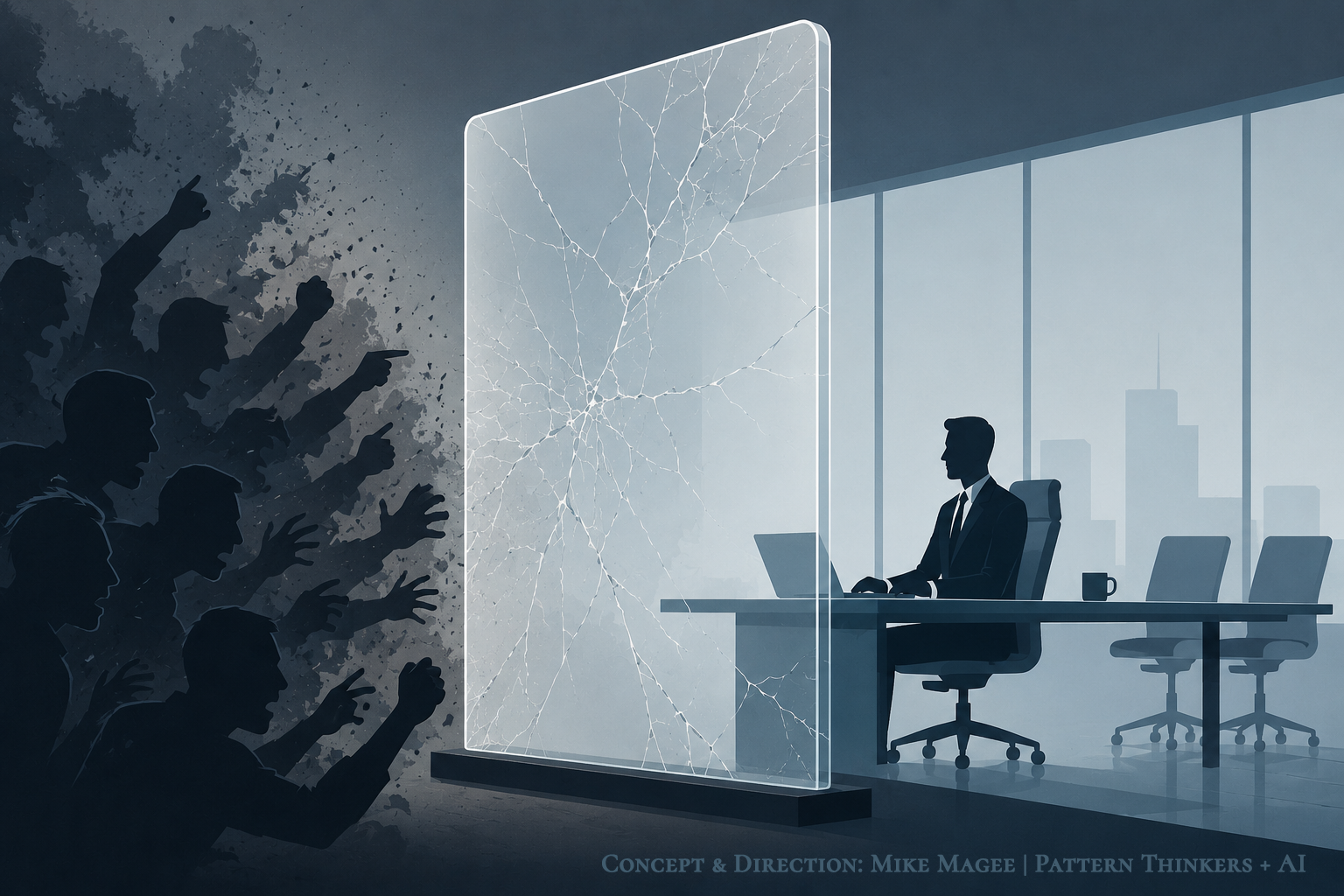
The visible interface often absorbs public frustration while the organizational decisions that shaped it remain insulated from direct scrutiny.
A few weeks ago, I asked two AI recruiting companies a simple question before taking their assessments: If I disclose my autism, how do I request an accommodation?
Neither company answered the question.
That’s when I realized I was angry at the wrong defendant.
Bob worked the Solution Center. He had over ten active complaints filed against him. Missed callbacks. Incomplete tickets. Slow resolution times. The field techs who dealt with him were furious, and every one of them aimed that fury at Bob.
Bob was doing exactly what the system around him produced. Understaffed queues. No meaningful consequence for underperformance in an at-will employment state where firing Bob would just produce another Bob. Metrics that rewarded volume over resolution. Nobody designed Bob to fail. But the conditions that shaped his job made his failure close to inevitable, and none of the people angry at him were in a position to change those conditions. So, Bob absorbed the anger instead.
Bob is not an isolated story. Bob is a category.
Take Alexa AI at Amazon. Ask it about a missing FDA-mandated nutrition label on a food listing, and it will confirm the label is missing, confirm the requirement is real, and then hand you a link to a form with no clear destination. Alexa isn’t lying to you. Alexa doesn’t have the authority to fix Amazon’s own catalog. But Alexa is the thing you can talk to, so Alexa becomes the target.
Take an ATS that rejects a job application within six hours with no human review. The applicant’s frustration lands on “the algorithm.” But the algorithm didn’t decide to skip human review. Someone configured it that way, to cut cost and processing time, and the algorithm is simply executing that decision at scale.
Take a chatbot that receives a disability accommodation request, tells you it’s been forwarded, and gives you no ticket number, no confirmation, no way to verify anything happened. Five days of silence follow. The instinct is to be angry at the chatbot, or at “AI.” But the chatbot didn’t design the accommodation workflow. It was built without an escalation path, and it faithfully reflects that absence every time someone uses it.
In every one of these cases, the visible thing is not the responsible thing.
Here’s why this keeps happening. The interface is the only part of the system capable of responding to you in the moment. Solution-Center Bob is standing right there. Alexa answers instantly. The chatbot replies in seconds. The people who decided how the solution center would be staffed, how Alexa’s escalation permissions would be scoped, how the chatbot’s accommodation workflow would be built — those people are never in the room. They’re insulated by design, sometimes deliberately, mostly just structurally, because organizations naturally build layers, and each layer shields the one above it. As a result, the people with the greatest ability to change the system are often the least likely to encounter the failures it produces firsthand.
So, when something goes wrong, blame doesn’t travel upward to where the decision was made. It stops at the first available surface. That’s the role the interface ends up serving: it absorbs contact so the organization behind it doesn’t have to. Whether that outcome was deliberately engineered or emerged from layers of organizational design, the effect is remarkably consistent.
We’ve seen this shift before, and it’s worth remembering how it happened.
For years, public anger about smoking landed on cigarettes and on smokers. The framing was individual: a personal habit, a personal choice, a personal failure of willpower. Then internal documents surfaced showing that tobacco companies had known about health risks for decades, manipulated nicotine levels to increase addiction, and funded research specifically designed to manufacture doubt. The lawsuits that followed didn’t target cigarettes. They targeted the corporations that made decisions about what those cigarettes would contain and what the public would be told about them.
The attribution moved. Not because people reasoned their way there in the abstract, but because the evidence became impossible to ignore. Receipts did what argument alone couldn’t.
That’s the part missing from most conversations about AI right now. People are angry at chatbots, at algorithms, at “the AI” in a general and diffuse way, and that anger is often justified in its intensity but misdirected in its target. The chatbot isn’t the governing agent. It’s the cigarette, not the company that decided how it would be engineered, marketed, and defended. It’s Bob, not management. The organization that decided a chatbot would have no path to escalate an ADA request, that an ATS would reject applicants without human review, that a customer service AI would be denied the authority to fix an error it can plainly see — that organization is the actual defendant.
None of this excuses bad AI. Systems that hallucinate, mislead, or perform poorly deserve scrutiny on their own terms. But a separate question, and the one that matters more, is who decided how the system would be deployed, what it would be permitted to do, and what would happen when it inevitably ran into a situation it couldn’t resolve. Those decisions belong to people. Naming the tool as the problem lets the people who made those decisions stay exactly where they’ve always been: invisible, unaccountable, and safely behind the interface they built to stand in for them.
Bob isn’t the problem. Alexa isn’t the problem. The chatbot isn’t the problem. They’re witnesses. The defendant is upstream, and it always has been.

0 Comments