
The Invisible Qualification
Inside The Hiring System – A Four-Part Series
by Mike Magee
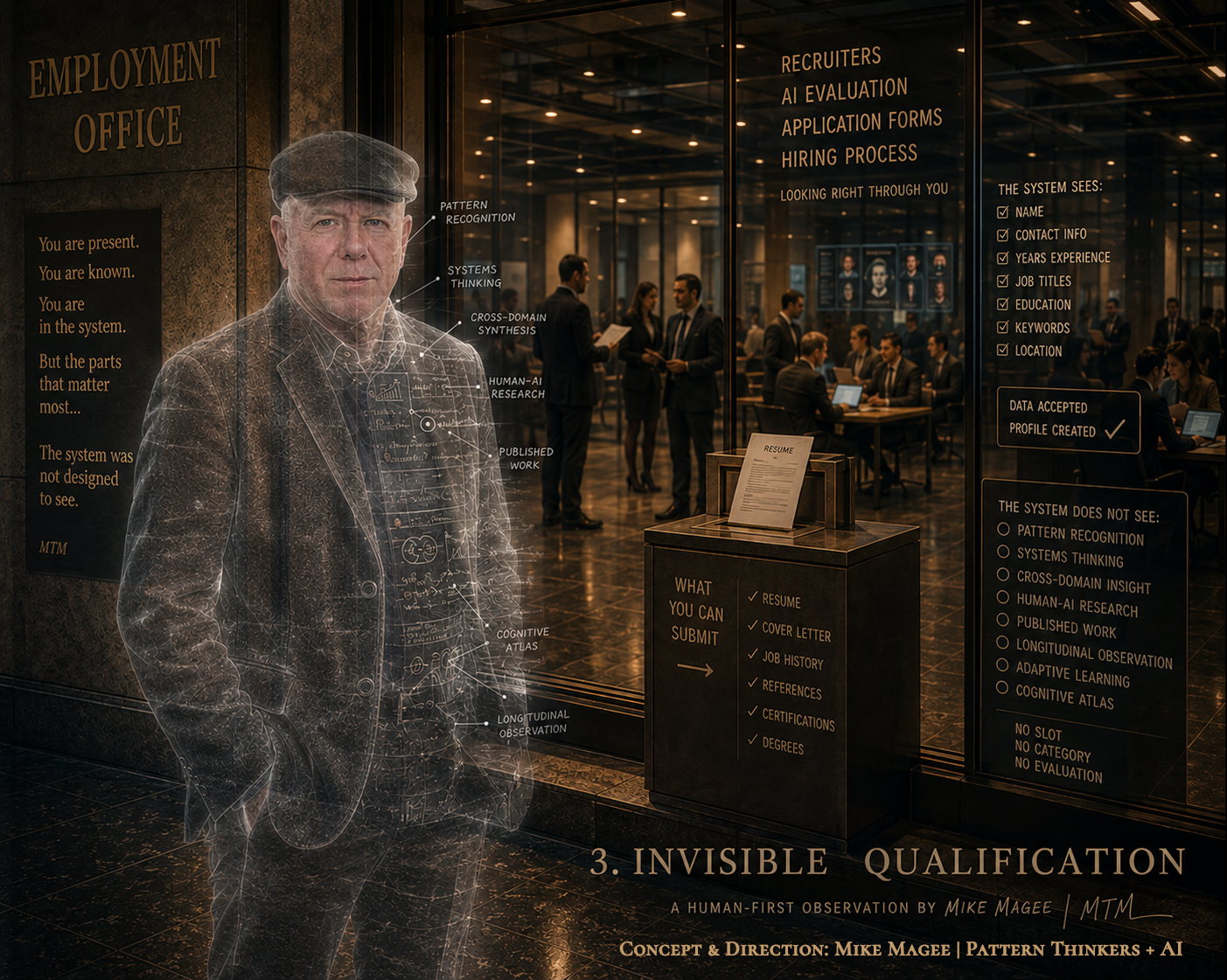
The qualification exists. The category does not
Article 3— A 4-Part Series: The Invisible Qualification
Inside the Hiring System — A Framework Reflection
There is a category of qualification that does not have a field on any application form.
It is not a certification. It is not a degree. It is not a list of platforms, tools, or methodologies. It cannot be expressed as years of experience in a role, because the experience that produces it does not happen inside a role. It happens inside a life.
I am going to call it invisible qualification. And I want to argue that it is frequently the most relevant thing about a candidate — and that the hiring architecture, as currently designed, has no reliable mechanism for seeing it.
The hiring system is built around legible signals.
Credentials. Job titles. Tenure. Keyword alignment. Institutional affiliations. These are the data points the system was designed to process, because they are standardized enough to compare across candidates at scale.
The standardization is necessary. No organization can evaluate thousands of applications through purely qualitative judgment. The system needs to compress complex human beings into comparable units, and legible signals are how that compression happens.
The problem is what gets lost in the compression.
Some of the most significant things a person brings to a role are not legible in the format the system requires. They exist in the gap between what a resume can hold and what a person actually is. And the wider that gap — the more a candidate’s most relevant capabilities live outside the standardized signal set — the more completely the system fails to see them.
I was diagnosed in my mid-fifties with ASD Level 1, though I have never found labels particularly useful for understanding how I think. Long before the diagnosis, I had spent decades navigating professional and social environments that were not designed around the way I process information, communicate, or approach problems. I learned to mask — to compress my natural cognitive style into forms legible to environments built around a different default. I learned to translate constantly, in real time, between how I actually perceived a problem and how the people around me expected it to be presented.
That translation work is exhausting in ways that are difficult to explain to people who have never had to do it. But it also produced something.
Sustained exposure to the gap between how I naturally process the world and how most systems expect information to be organized gave me an unusually precise sensitivity to systems themselves. To the assumptions embedded in their design. To the places where the official model and the operational reality diverge. To the mechanisms hiding beneath the labels that most people accept without inspection.
That sensitivity is not incidental to the work I do. It is foundational to it. It is part of what allows me to see what others miss, ask the questions others do not think to ask, and identify structural failures that only become visible when you have spent a lifetime noticing the gap between what systems claim to do and what they actually do.
None of that appears on a resume. There is no field for it. The ATS has no mechanism to score it. The keyword matching algorithm cannot find it because there is no standardized vocabulary for it.
It is invisible to the system. And it is the most relevant thing about me for a significant range of roles.
ASD is one example. It is not the full argument.
Invisible qualification is a broader category than neurodiversity, though neurodivergent people experience its consequences with particular intensity because the gap between their capabilities and the system’s ability to see those capabilities is often especially wide.
Consider the veteran whose most significant qualification is the ability to maintain functional judgment under conditions of genuine uncertainty and consequence — something no civilian resume section adequately captures.
Consider the person who spent a decade as a primary caregiver, developing organizational, crisis management, and interpersonal capabilities under sustained pressure, with no institutional record of any of it because the work happened outside any organization.
Consider the career changer whose decade in a completely different field produced a cross-domain pattern recognition that makes them genuinely more capable in the new role than someone who has only ever worked inside it — but whose resume reads as deficient because the keyword alignment is low.
Consider the person who built deep expertise through self-directed learning, practice, and direct engagement with real problems rather than through credentialed institutional pathways — whose knowledge is demonstrably real but whose signals are nonstandard.
In each case, the most relevant qualification is the one the system cannot see. And in each case, the system makes a decision based on what it can see — which is a partial, compressed, standardized representation of a human being — and treats that decision as an evaluation of the person.
It is not. It is an evaluation of the resume. Those are not the same thing.
There is a specific version of this problem that I want to name directly because I think it represents the sharpest form of the contradiction.
I applied to a company whose entire stated mission is supporting people with ASD.
The role matched my technical background with precision. The experience requirements mapped directly to work I have performed for years.
But there was another qualification that no section of the application had any meaningful way to evaluate.
I have spent my entire life inside the experience the company exists to serve. Not as an observer. Not as a researcher. Not as a clinician approaching the subject from outside.
As someone for whom that experience is not a professional specialty but a lived reality — daily, continuous, and inseparable from how I think, work, and navigate the world.
I am not suggesting that lived experience automatically qualifies anyone for any role. It does not.
Qualification requires both relevant experience and the demonstrated capability to apply it effectively.
What I am suggesting is something much simpler. Some forms of expertise are difficult to represent inside standardized evaluation systems.
A resume can represent certifications, job titles, years of experience, keyword alignment, and institutional affiliation.
What it struggles to represent is understanding that emerges from direct participation in the problem itself.
For a company whose mission centers on a specific human experience, that distinction matters.
The contradiction is not that a candidate was rejected. The contradiction is that the system may be incapable of recognizing a category of qualification that is directly relevant to the mission it exists to advance.
I am not asking for special treatment. I am asking whether some forms of human understanding deserve evaluation by a human being before they are reduced to a score.
What would it look like to design for invisible qualification?
Not to abandon standardized signals. They serve a real function.
Removing them entirely would introduce different failures.
But to build deliberate mechanisms for surfacing what the standard signals cannot carry.
It might look like structured interview questions designed to surface experiential knowledge rather than credential knowledge.
It might look like portfolio-based evaluation for roles where the work product is more informative than the resume.
It might look like explicit review processes for applications that score below threshold but carry non-standard signals worth human attention.
It might look like asking different questions entirely.
Not:
“Does this person’s history match our template?”
But:
“Does this person understand the problem we are trying to solve in a way that would make them effective here?”
The hiring system sees what it was designed to see. It was designed to see standardized signals at scale.
The problem is not that it fails to recognize talent.
The problem is that it cannot reliably recognize forms of qualification that exist outside the vocabulary of the system itself. — The veteran, the caregiver, the career change, the self-taught expert.
The person whose most relevant understanding emerged through direct experience rather than institutional pathways.
The system is not evaluating those forms of qualification and rejecting them.
In many cases, it never meaningfully sees them at all.
That is a design problem, not a personal one. Design problems have solutions.
But solutions require acknowledging that representability and capability are not the same thing.
The hiring system sees what it was designed to see. The question is whether what it sees is sufficient.
Until that question is taken seriously, some of the most relevant qualifications in an applicant pool will remain invisible — not because they lack value, but because the system evaluating them has no vocabulary for recognizing them.
This article is part of a four-part series examining modern hiring as a system:
- The AI Gatekeeper Problem
- The Social Capital Lottery
- The Invisible Qualification
- Four Months Inside the System
Next in the series:
Four Months Inside the System — a field study from inside modern hiring systems, documenting the patterns, contradictions, and mechanisms that emerged through direct participation.

0 Comments