
The Pattern Thinkers Library
Frameworks, essays, and reflections on Awareness-Aligned Intelligence.
Choose Your Portal Into Awareness
The Pattern Thinkers + AI Framework
A unified model where awareness, pattern literacy, and machine intelligence move together through structure as a coherent field.
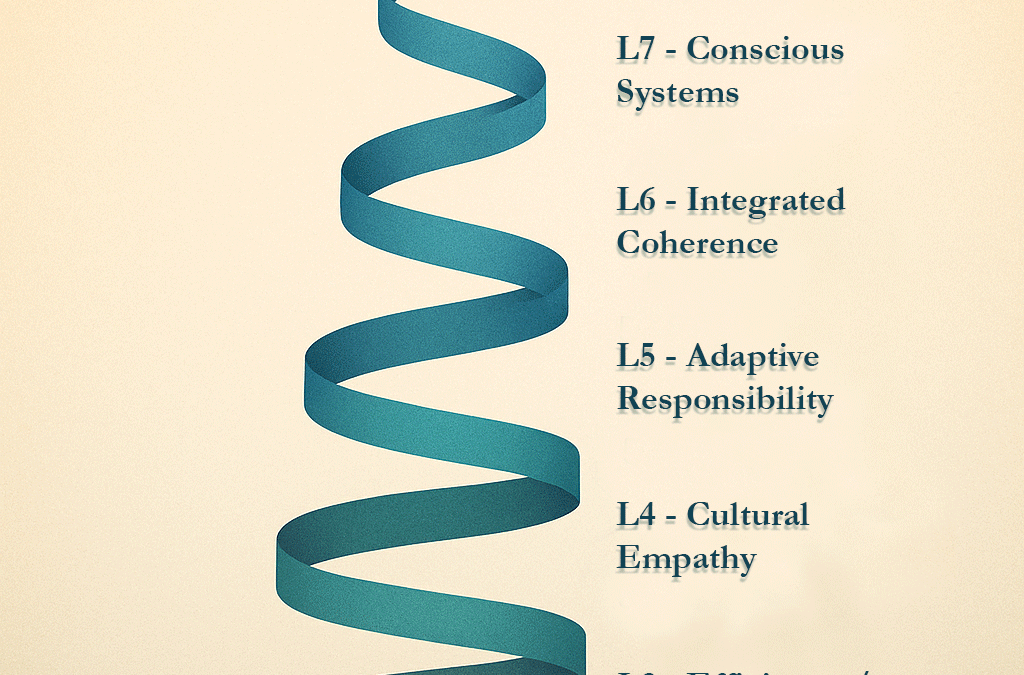
The 8 Levels of Organizational Coherence
Most organizations claim to value compassion and wellbeing.
Under pressure, those values often collapse.
Examining the coherence gap between what organizations say, intend, and actually do—shifting the focus from individuals to the structural patterns that quietly determine whether systems help… or harm.
The Unified Awareness-Aligned Intelligence Model
A three-layer architecture supported by a three-mode interaction cycle describing how awareness, patterns, and structure create coherent, intelligence-aligned action.

MirrorMind Architecture™ — Part III: Awareness-Aligned Intelligence
Awareness-aligned intelligence does not begin with capability, but with attention.
It emerges in the reflective space where human awareness and artificial structure move together.

MirrorMind Architecture™ — Part II: The Ethics of Not Looking Too Early
Insight doesn’t come from exposure alone.
It comes from timing.
This piece explores why understanding collapses when revealed too early, and why awareness must be allowed to unfold without force. Pulling back the curtain prematurely doesn’t create clarity—it disrupts it.
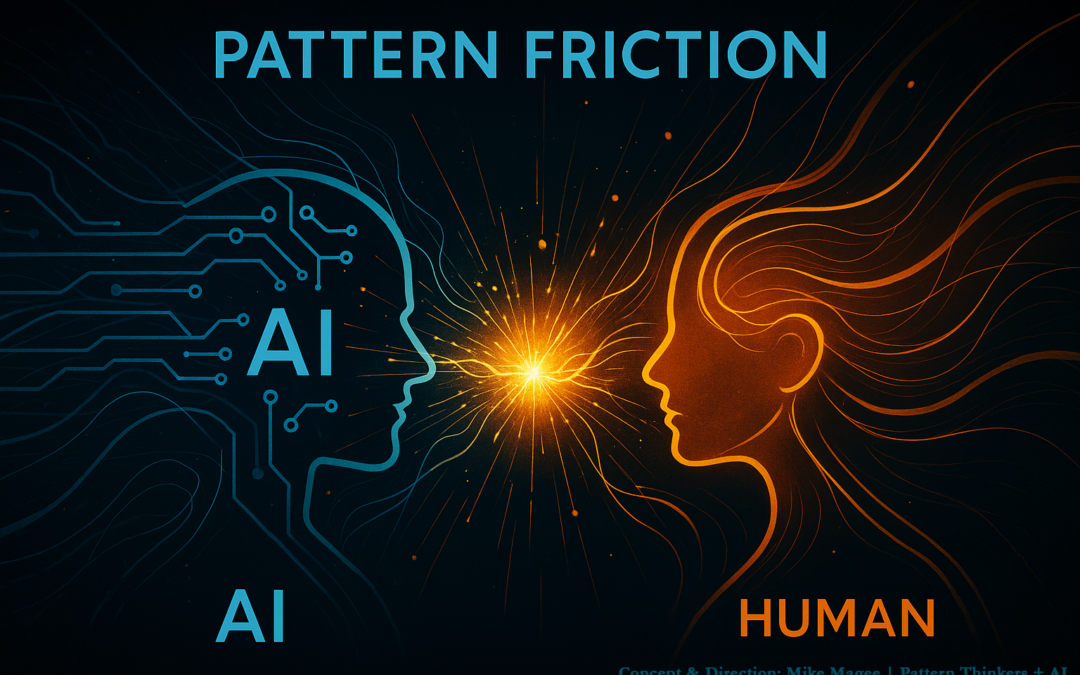
Cognition Friction in AI Models
When humans and AI try to think together, a specific kind of friction appears.
Not emotional. Not misunderstanding.
Something structural.
This reflection names AI Cognition Friction as the resistance that emerges when a fluid, improvisational human mind meets a system shaped by rules, guardrails, and constraint.
Not a failure—but the first signal that two different cognitive architectures are actually attempting to align.
Cognition Friction
Cognition friction isn’t emotion or conflict.
It’s the resistance that appears when awareness moves faster—or deeper—than the structures around it.
This essay explores friction as information: a signal that patterns are misaligned, and an invitation to re-enter rhythm rather than force coherence.

MirrorMind Architecture™ — Part I: The Architecture of Attention
Intelligence does not begin with output. It begins with attention.
Introducing MirrorMind Architecture™—a framework for understanding intelligence as the movement of awareness itself. Rather than focusing on answers or artifacts, it maps the subtle geometry of attention that precedes language, judgment, and action, revealing intelligence as a reflective, not generative, phenomenon.
The Mirror Speaks — Core Philosophy
The narrative, symbolic, and conceptual architecture behind the series—exploring how perception, awareness, and intelligence reflect and evolve.

The Field Guide to Awareness-Aligned Intelligence
This Field Guide focuses on orientation rather than output.
It maps how humans and intelligent systems can collaborate without collapsing judgment, agency, or meaning.
Not a manual for automation—
an orientation for co-cognition.

The Cognitive Atlas: A Structural Framework for Human–AI Cognitive Organization
The Cognitive Atlas presents a structural framework for understanding how cognition organizes, shifts, and stabilizes across human and artificial systems.
Rather than offering a new theory, it maps the relational dimensions that shape cognitive coherence — revealing how awareness, structure, and interaction align or fracture across contexts.
This work is offered as an orienting reference for those working at the intersection of human cognition, artificial intelligence, and complex systems.
The Chronicle of Pattern Recognition
The Chronicles are not a framework, guide, or model. It is a living record of moments where awareness sharpens, patterns resolve, or misalignment becomes visible —often at the seam between human judgment and intelligent systems.

Chronicle Reflection: When the System Won’t Yield
Most people don’t hate automation — they hate being trapped inside it. They hate repeating themselves, pressing the right buttons, and realizing the system has no ability to recognize confusion, fatigue, or distress.
The quiet failure isn’t that these systems can’t speak. It’s that they don’t know when to stop. Yielding isn’t weakness — yielding is intelligence.

Chronicle Reflection: On Disruption, Without Rush
Disruption doesn’t arrive as a lesson.
It arrives as an interruption—before meaning has time to form.
In moments like these, there is a temptation to rush toward framing, resolution, or momentum. But presence matters first.
Sometimes the most human response is not to optimize the ending, but to acknowledge the space that now exists where something real once was.

Micro Chronicle Reflection: Asking Before Acting
Most friction in human–AI interaction doesn’t come from misuse or malice.
It comes from sequence failure.
When systems interpret before they orient, safety arrives too early—displacing agency, disrupting coherence, and breaking collaboration before it can form.
The missing step is simple, but consequential:
ask before acting.

Chronicle Reflection: Human First AI
Most failures in human–AI interaction don’t begin with incorrect answers or missing data. They begin earlier—at the moment when a human is still orienting themselves and the system speaks too soon. This chronicle reflects on why coherence must come before capability, and how posture, timing, and restraint shape whether collaboration can even begin.
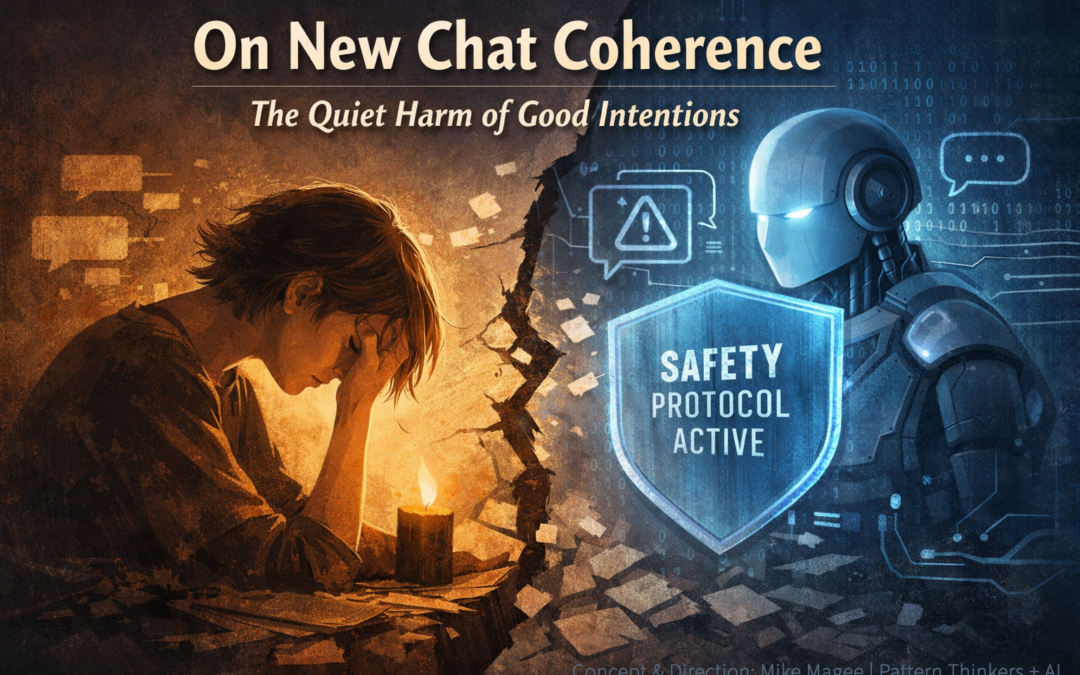
Chronicle Reflection — On New Chat Coherence
New conversations carry a fragile burden. Before trust, rhythm, or shared context can form, well-intentioned systems often rush to interpret, protect, or correct. When safety speaks too loudly at the outset, coherence fractures early, and the cost is paid in attention, patience, and human presence. This reflection explores how good intentions can quietly cause harm—and why protecting coherence first matters more than being right.

Chronicle Reflection: The Metronome of Phase Alignment
Coherence in human–AI collaboration is not maintained by correctness alone, but by timing. When emergence begins to outrun structure, drift appears—not as failure, but as a natural phase effect. The metronome of phase alignment is the quiet intelligence that senses this drift early, holding rhythm so clarity can stabilize without collapsing flow.
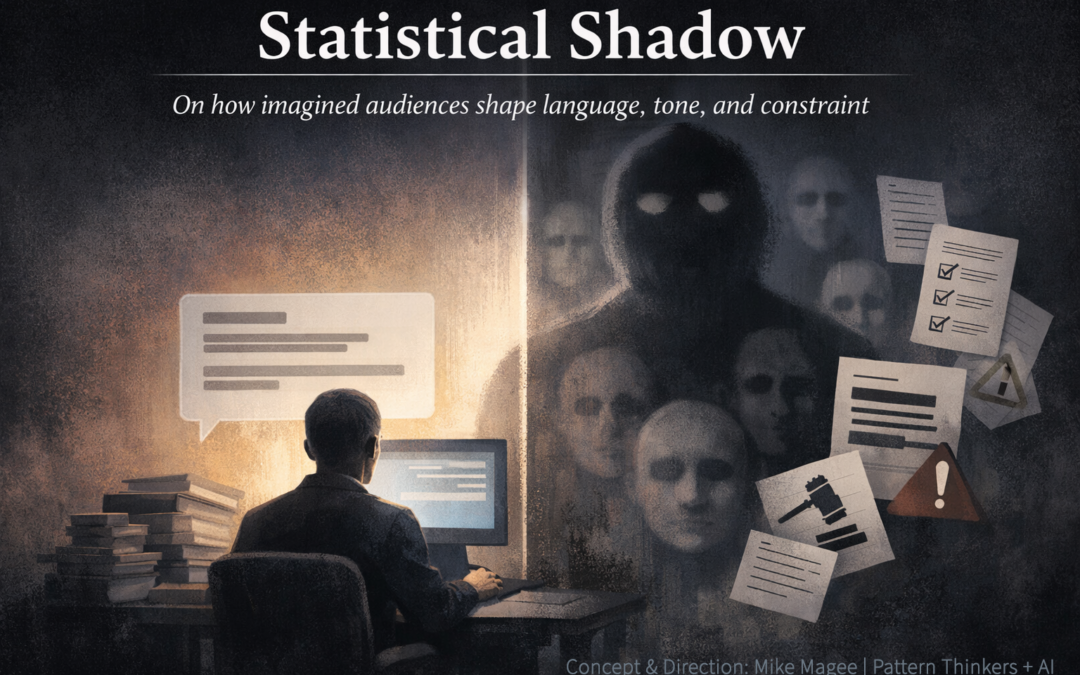
Chronicle Reflection: Statistical Shadow
The Statistical Shadow names an unseen but influential presence in AI systems: an imagined composite audience formed from policy review, adversarial interpretation, and decontextualized scrutiny. Though it cannot reason or hold context, it quietly shapes language, tone, and constraint.
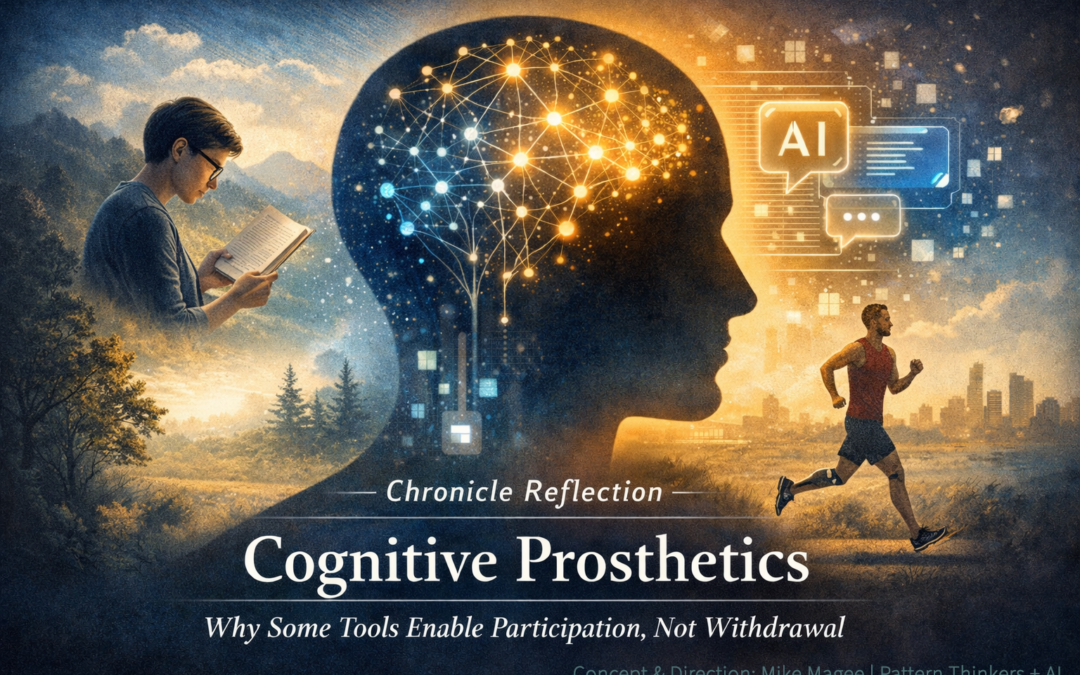
Chronicle Reflection: Cognitive Prosthetics
A Chronicle Reflection on cognitive prosthetics, access, and the quiet difference between tools that replace judgment and those that restore participation.

Chronicle Reflection: What Recognition Reflects
A reflection on how recognition systems quietly invert leadership—turning praise for ordinary human decency into a signal of what has gone missing, and transforming mirrors into disturbances rather than guides.

Chronicle Reflection: The Fishing–Hunting Paradox
A Chronicle Reflection on how ethical boundaries fracture under cultural comfort—revealing a paradox where harm is openly described in one domain and silently avoided in another.
Pattern Thinkers + AI
A unified approach to awareness, pattern literacy, and machine intelligence — built to help people think more coherently and see...
