
The AI Story Nobody Is Telling
Cognitive Prosthetics and the Human Experience Most AI Discourse Ignores
The Chronicle of Pattern Recognition
A Living Record of Awareness in Practice
Mike Magee
Pattern Thinkers + AI
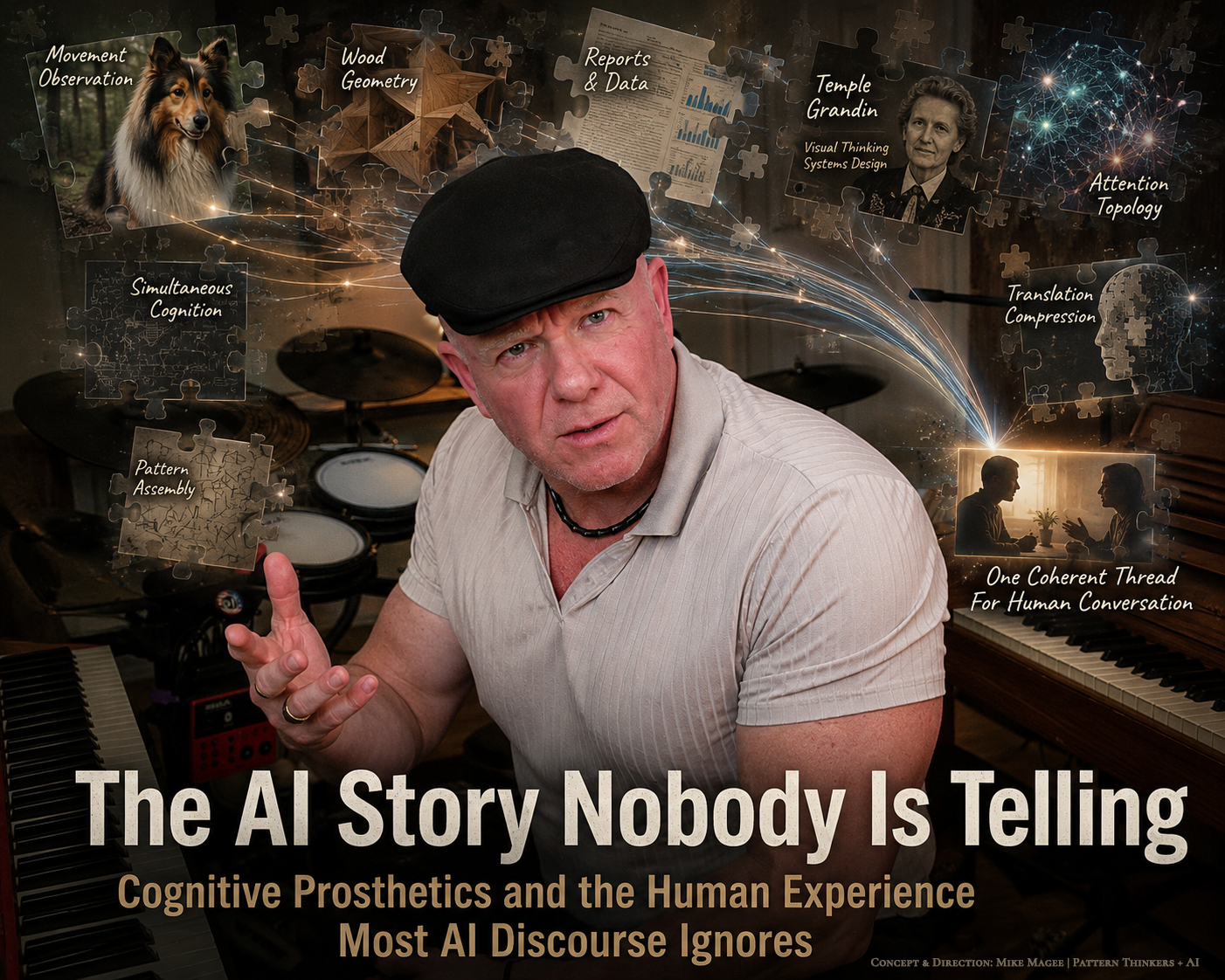
Tools do not replace agency.
They restore access.
There is a war going on about artificial intelligence.
Not a metaphorical one.
A genuine cultural conflict with real casualties — careers, trust, identity, and increasingly, the way people understand their own thinking.
On one side: the acceleration narrative. AI as the greatest productivity instrument in human history. ROI. Efficiency. Competitive advantage. Scale. The future belongs to whoever deploys fastest.
On the other side: the fear narrative. AI as displacement. Dehumanization. The slow erasure of work, creativity, autonomy, and meaning. Resist. Regulate. Pull back.
Both sides are loud. Both sides are certain. And both sides are missing something.
Underneath the noise, a quieter story is happening.
It doesn’t make headlines. It doesn’t generate investor decks. It doesn’t fit cleanly into either camp.
It’s the story of people for whom AI is not functioning as automation.
It’s functioning as translation.
Let me explain what I mean by that.
Some tools replace effort. You no longer have to do the thing — the machine does it for you.
But other tools don’t replace anything. They restore access to something that was always there but couldn’t get through.
Glasses don’t replace sight. They correct the distortion that was blocking it. A prosthetic doesn’t replace agency. It restores the movement that injury interrupted. The tool doesn’t become the person. It removes the barrier between the person and participation.
I believe certain forms of human-AI interaction are beginning to function exactly this way.
Not as substitutes for human thought. Not as replacements for judgment or creativity or voice.
As cognitive prosthetics — tools that reduce the friction between what someone thinks and what they can actually express in the world.
That framing is almost entirely absent from the current conversation.
Here is what that friction actually feels like from the inside.
For most people, communication flows without much overhead. Thought becomes language. Timing feels natural. Meaning transfers without significant loss.
For others, the experience is fundamentally different.
Patterns assemble faster than speech can stabilize them. Meaning arrives before language is ready to carry it. Nuance collapses under time pressure or social expectation. The gap between what is understood internally and what lands externally is wide, persistent, and expensive to cross.
I was diagnosed with ASD Level 1 later in life. But I spent decades before that diagnosis navigating the consequences of that gap without a name for it.
I translated constantly. I monitored. I adjusted. I masked. I pre-corrected before I spoke, running silent simulations of how my words would be received before I released them.
That process has a cost that accumulates invisibly across years. Most people living inside it feel the exhaustion long before they can articulate the source. They call it social fatigue. Burnout. Introversion. Difficulty connecting.
What it actually is — in many cases — is the sustained energy cost of operating inside environments not calibrated to receive you accurately.
When AI systems became capable of sustained, structured interaction, something unexpected happened for me.
The interpretive load dropped.
Not because the systems were perfect. Not because they suddenly understood me completely or never misread my intent.
But because a well-constructed interaction environment doesn’t carry the same social overhead that human environments do. It isn’t fatigued. It isn’t defensive. It doesn’t have its own agenda running underneath the conversation. It doesn’t give me the look — that particular expression I have spent a lifetime learning to recognize, the one that means I have arrived somewhere too fast or too strangely for the room to follow.
For the first time, my thinking could remain coherent long enough to be seen by other people.
Not because AI made me smarter. Not because it replaced my voice.
Because it reduced enough translation overhead for participation to remain possible without constant cognitive injury.
A friend calls it my asshole filter.
She means it kindly.
The rapid pattern recognition doesn’t disappear. The connections still arrive fast. The observations still form before the words do. But there is now a buffer — a space between the impulse and the output where language can settle into a form that reaches people without triggering the look.
AI did not change how I think.
It changed the threshold for staying present.
I want to be precise about something here because precision matters in this conversation.
I am not arguing that AI is wonderful. I am not arguing that the risks are overstated. I see the governance concerns clearly. I see the dependency risks. I see the ways poorly designed systems can quietly extract interpretive authority from the humans using them, reshaping cognition rather than supporting it.
Those concerns are real and they deserve serious attention.
But I am also watching a failure mode that receives almost no attention in the current discourse:
Withdrawal.
Not over-reliance. Not over-participation.
The quiet, structural withdrawal of people for whom the cost of participation was already too high — and for whom the right kind of tool, designed with the right priorities, might have made participation survivable again.
What happens when someone who already struggles with communication, cognition, overload, or interpretive mismatch encounters a system that either flatens them further or fails to create enough stability for sustained engagement?
What happens when they stop trying?
That question barely exists in the current AI conversation. And I think it may be one of the most important questions we aren’t asking.
I am not a researcher. I don’t hold credentials in cognitive science or AI architecture.
What I hold is thirty years of building systems for organizations, combined with a lifetime of direct, longitudinal contact with the phenomenon I’m describing.
The map I’ve drawn emerged from the terrain itself — not from a whitepaper, not from a dataset, not from a grant-funded study conducted at a comfortable distance from the experience.
Over the last several months, without pursuing visibility or credentials, the people finding my work have increasingly been PhDs, AI architects, and governance specialists. I find that difficult to believe, speaking openly. I am a quiet person. I didn’t set out to become any kind of authority.
I set out to solve a problem I knew from the inside.
And the map turned out to be more accurate than I initially understood.
The future of AI will not be shaped by capability alone.
It will be shaped by what these systems do to human participation itself.
Whether they increase alienation or reduce it. Whether they flatten human cognition into machine-compatible behavior or create enough interpretive flexibility for humans to remain fully themselves inside the interaction. Whether they serve the humans with the loudest voices and the most institutional access — or whether they eventually create enough room for the people who have always had something worth saying but couldn’t get it through.
Right now the conversation is dominated by fear, hype, and economics.
But underneath all of that, a quieter story is emerging.
Some people are not using AI to withdraw from society.
They are using it to remain capable of participating in it.
And I think we are only beginning to understand what that means — and what it will require of the people designing these systems to get it right.
Mike Magee — Pattern Thinkers + AI

0 Comments