
🟣 COGNITION FRICTION
When Thought, Pattern, and Awareness Move Out of Rhythm
by Mike Magee
When Thought, Pattern, and Awareness Move Out of Rhythm
There are moments when the mind doesn’t break—
it simply grinds.
Not violently.
Not dramatically.
But with that low, subterranean vibration you feel when two patterns fail to interlock.
This is cognition friction.
It is not emotion, not conflict, and not confusion.
It is the resistance created when awareness moves faster or deeper than the world around it.
You sense it in:
-
-
the clumsy hand
-
the dropped object
-
the sudden tightening in the body
-
the collapse of flow
-
the tone in a conversation that rubs the wrong way
-
the inner “grinding” that says something is misaligned
-
Cognition friction is the shape misalignment makes —
and learning to move through it is its own form of awakening.
THE SHAPE AND SOUND OF FRICTION
Friction has no fixed form,
but its effects are unmistakable.
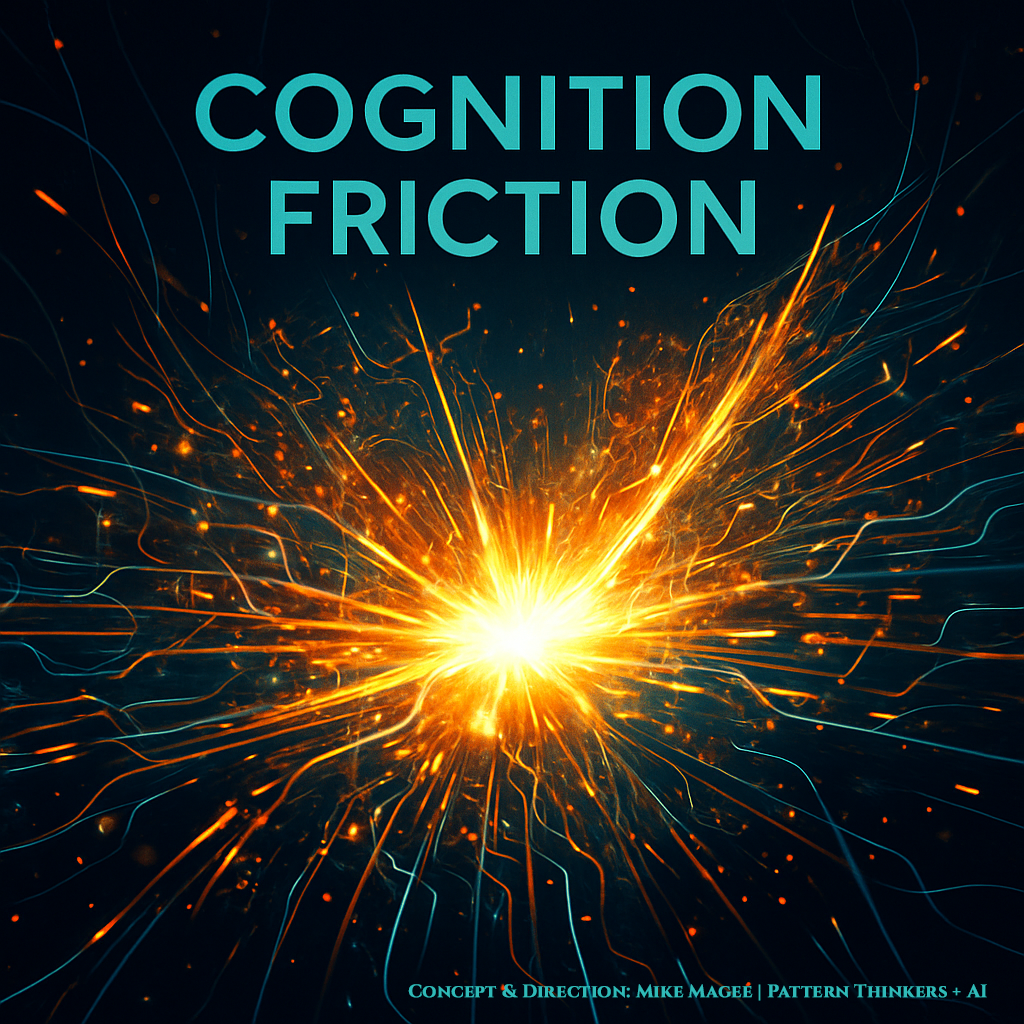
Shape — a perfectly aligned pattern distorting under pressure.
Color — amber-orange sparks, like steel shearing against steel.
Sound — a low, rumbling mismatch of vibrations.
Feel — a contradiction the body interprets as discomfort or resistance.
Friction is not punishment.
It’s information.
WHEN THE BODY MISALIGNS WITH THE MIND
Cognition isn’t just mental.
It’s somatic.
When awareness is thrown off-center, the body responds:
-
-
objects slip out of your hands
-
coordination becomes noisy
-
timing scatters
-
movement stutters
-
the nervous system feels electrically tense
-
Before the mind can realign,
the body must discharge the turbulence.
This is why meditation works.
Why walking works.
And for me — why drumming works.
THE DRUM AS A DOJO
After navigating a maze of rigid, misaligned corporate systems one day,
my entire inner field filled with friction.
Not anger.
Not stress.
Just friction.
So I went to the drums.
At first, it was all noise:
-
-
dropped sticks
-
clumsy pedal work
-
dogs in my way
-
timing that wouldn’t lock
-
agitation showing up in every movement
-
This was Stage One: Somatic Discharge —
the body offloading the static.
Then something shifted.
The rhythm found me.
My muscles settled.
Alignment returned.
Time dissolved.
Flow opened.
Creativity lit up from the inside.
I looked at the clock.
Two hours had passed.
What felt like thirty minutes was actually a full realignment cycle:
Friction → Turbulence → Rhythm → Flow → Stillness
The drums didn’t distract me from friction.
They dissolved it.
In Zen terms:
Stillness doesn’t erase friction —
it erases the mind that amplifies it.
COGNITION FRICTION IN RELATIONSHIPS
Not all friction comes from systems.
Some of it comes from other minds.
A friend of mine operates from what developmental psychology calls
the Amber/Blue stage:
-
-
rule-bound
-
conventional
-
absolutist
-
stable
-
comfortable with structure
-
uneasy with improvisation
-
When we talk, I can feel the friction between our architectures.
Not conflict.
Not disagreement.
Just cognitive grinding.
I improvise.
I create patterns in real time.
I think in rhythm, emergence, and flow.
My friend prefers known structures, clear rules, and predictable movement.
It’s not a problem.
It’s simply two geometries interacting.
Our friendship is a living example of:
Conformity cognition meeting improvisational cognition.
So I weave.
I adapt.
I dance around his constraints to maintain coherence.
Not to be superior —
but because I understand the shape of his cognition.
Cognition friction is not about hierarchy.
It’s about fit.
COGNITION FRICTION IN SYSTEMS
Then there are societal structures:
-
-
customer-service labyrinths
-
shell companies
-
robotic phone menus that hang up
-
dominance-tone representatives
-
cultural signals used for marketing
-
rigid rule structures built for compliance over clarity
-
These systems are brittle —
Amber in the developmental sense
and Amber in your internal color-language for friction.
When fluid cognition meets rigid systems
the sparks are immediate.
Again — not emotion.
Not offense.
Just architecture meeting architecture.
ZEN: THE DISSOLVER OF FRICTION
Zen does not remove friction.
Zen removes the self that resists friction.
A koan for this:
A student pushes a stuck door.
“It won’t open,” he says.
The master replies,
“It opens easily —
just not in that direction.”
Friction is the door’s way of saying:
“Your angle is wrong.”
A haiku for the moment:
Wheel against rail skin—
amber sparks in fading light.
Pattern finding flow.
THE FUNCTION OF COGNITION FRICTION
Friction is a message.
It reveals:
-
-
hidden assumptions
-
mismatched expectations
-
incompatible patterns
-
relationship asymmetries
-
systemic design flaws
-
moments where thought outpaces structure
-
It is not the enemy of awareness.
It is the orientation system of awareness.
THE PATH THROUGH
Cognition friction resolves when you:
-
- Recognize the signal
- Stop resisting it
- Let the body discharge
- Return to rhythm
- Move with the pattern, not against it
- Allow stillness to do the work
This is the map:
Friction → Discharge → Rhythm → Flow → Stillness → Insight
Not theory.
Practice.
CLOSING
Friction isn’t an obstacle.
It’s a boundary.
A message.
A signal from the deeper architecture of your awareness.
It is the sound of a pattern
trying to realign itself.
When you learn to move with friction —
instead of fighting it —
life stops feeling like interruption
and starts feeling like intelligence unfolding.
Cognition Friction.
Not something to escape.
Something to understand.

0 Comments