
Artificial Help
Why Today’s Chatbots Understand the Problem but Still Leave the Work to You
by Mike Magee
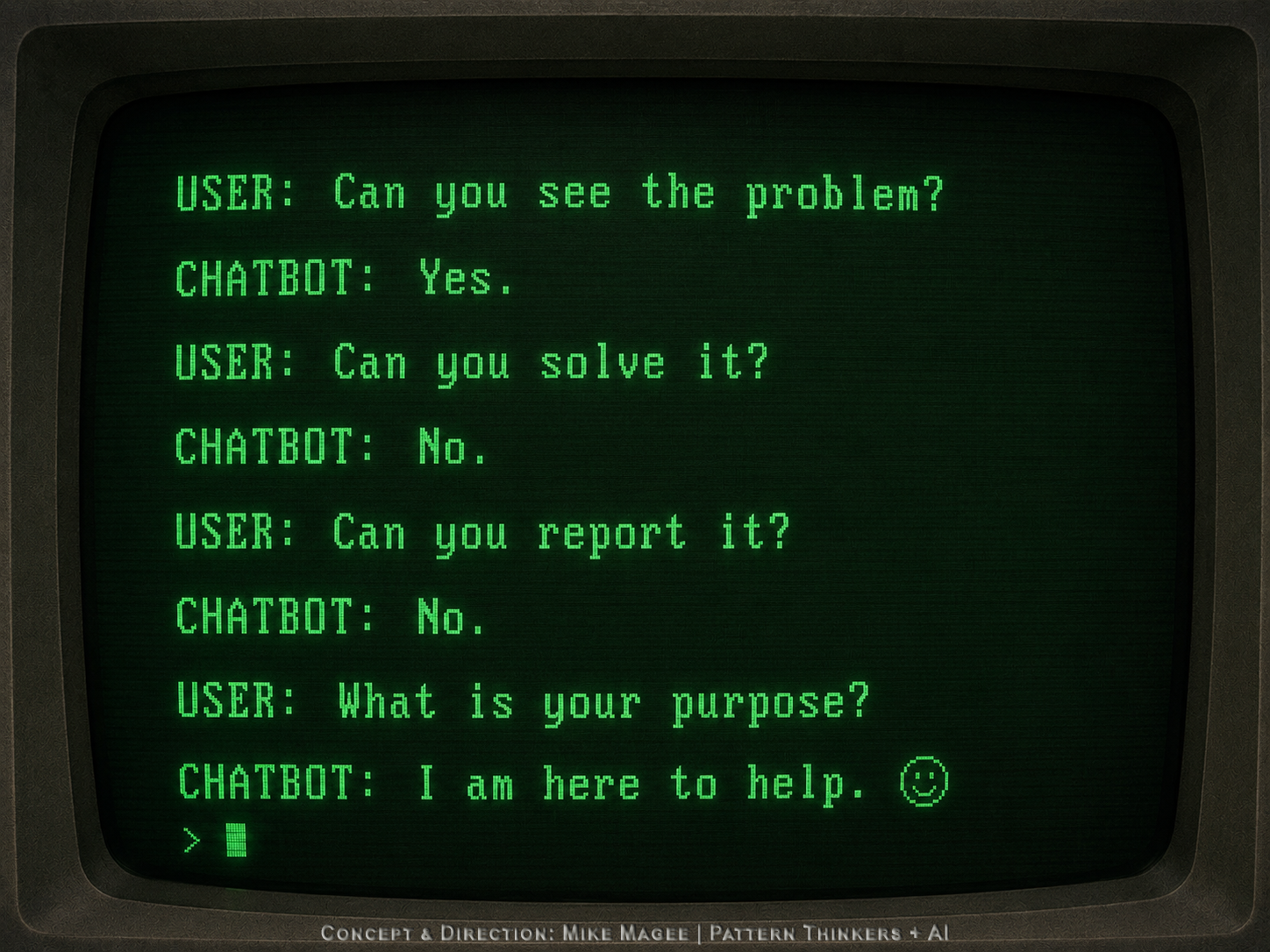
A chatbot recognizes the problem but cannot move the workflow forward. The conversation succeeds. The operational state does not.
Why Today’s Chatbots Understand the Problem but Still Leave the Work to You
Artificial intelligence is becoming remarkably good at recognizing problems.
It can identify pricing errors, missing information, incomplete forms, workflow failures, and even explain exactly why something went wrong. In many cases, it can determine the next appropriate step more quickly than the human using it.
So why does the work so often end there?
Over the past several months, I documented a series of interactions with AI-powered customer service systems operating in completely different industries. The companies themselves aren’t the point. What interested me was the architecture behind the conversations.
Despite serving different purposes, every system followed the same pattern.
The AI correctly identified the problem.
The AI explained the problem accurately.
The AI understood what needed to happen next.
Then the responsibility transferred back to me.
That pattern raises a larger question.
What role should AI play once it has correctly identified a problem?
The Shopping Experience
One interaction involved an online retailer selling packaged food.
A product listing did not display the complete Nutrition Facts panel that consumers normally rely on when evaluating food before purchase. The AI acknowledged that the information was incomplete and recognized that the listing lacked the full nutritional information I was looking for.
It then suggested several things I could do:
- Contact the manufacturer.
- Search elsewhere.
- Report the issue myself.
The AI understood the problem.
It simply couldn’t act on it.
In another interaction, the same retailer displayed an incorrect unit price for a multipack product.
The AI immediately recognized the error.
It calculated the correct price.
It explained exactly why the listing was wrong.
It even identified that the calculation had been based on the wrong package size.
Then it suggested I contact customer service.
Again, the intelligence wasn’t missing.
The operational authority was.
When the Workflow Matters More Than the Conversation
Another interaction involved an employment platform that uses AI within its hiring process.
I submitted documentation supporting a request for a reasonable accommodation under the Americans with Disabilities Act due to my diagnosed Autism Spectrum Disorder.
The chatbot accepted my documentation.
It indicated that the information would be reviewed.
Then… nothing.
No confirmation.
No case identifier.
No indication that an auditable process had actually begun.
Days later I returned simply to verify that my request had been received.
The chatbot could not confirm it.
Only after I explicitly requested that a human review my accommodation request did the system expose a pathway that allowed a formal support request to be created.
Whether that support request represented the organization’s intended accommodation process wasn’t the point.
The point was that the AI had recognized the nature of the request from the beginning.
The workflow did not transition into an observable, traceable process until I pushed the system further.
Again, the AI understood.
The burden remained with the human.
Intelligence Without Operational Authority
These examples all reveal the same architectural pattern.
Today’s chatbots often possess enough intelligence to:
- recognize a problem,
- explain it accurately,
- identify what should happen next,
while lacking the authority to initiate the next operational step.
The result is subtle but important.
The AI appears helpful because it understands the issue.
The human remains responsible because the workflow never actually advances.
Instead of reducing effort, the AI often creates a different kind of work.
Did my request actually get submitted?
Who received it?
Should I upload the information again?
Do I need to contact someone else?
Did anyone ever see what I provided?
The system answers the original question while creating several new ones.
This Isn’t About Smarter AI
None of these examples require more capable language models.
The AI already recognized the problem.
It already explained the problem.
The missing capability isn’t intelligence.
It’s integration with the operational systems responsible for resolving what the AI has already identified.
Imagine a different experience.
The AI detects a pricing discrepancy.
It automatically creates an internal catalog review.
The AI recognizes an accommodation request.
It initiates the organization’s accommodation workflow, generates a confirmation number, and informs the applicant that the request has entered review.
The AI identifies missing product information.
It opens an internal quality review while notifying the customer that the issue has been reported.
None of these actions require artificial general intelligence.
They require organizations to allow AI systems to participate in the workflows they already understand.
Artificial Help
As AI becomes increasingly embedded in customer service, hiring, healthcare, education, and government services, one question becomes increasingly important.
Should AI merely explain problems?
Or should it reduce the operational burden required to solve them?
Those are not the same thing.
An AI system that consistently recognizes problems but cannot initiate their resolution isn’t necessarily failing.
It may be performing exactly the role it was designed to perform.
The question is whether that role serves the organization, the human using it—or both.
Artificial intelligence should do more than recognize where organizational workflows have broken down.
It should reduce the effort required for humans to move those workflows forward.

0 Comments