
📜CHRONICLE REFLECTION: On New Chat Coherence
The Quiet Harm of Good Intentions
by Mike Magee
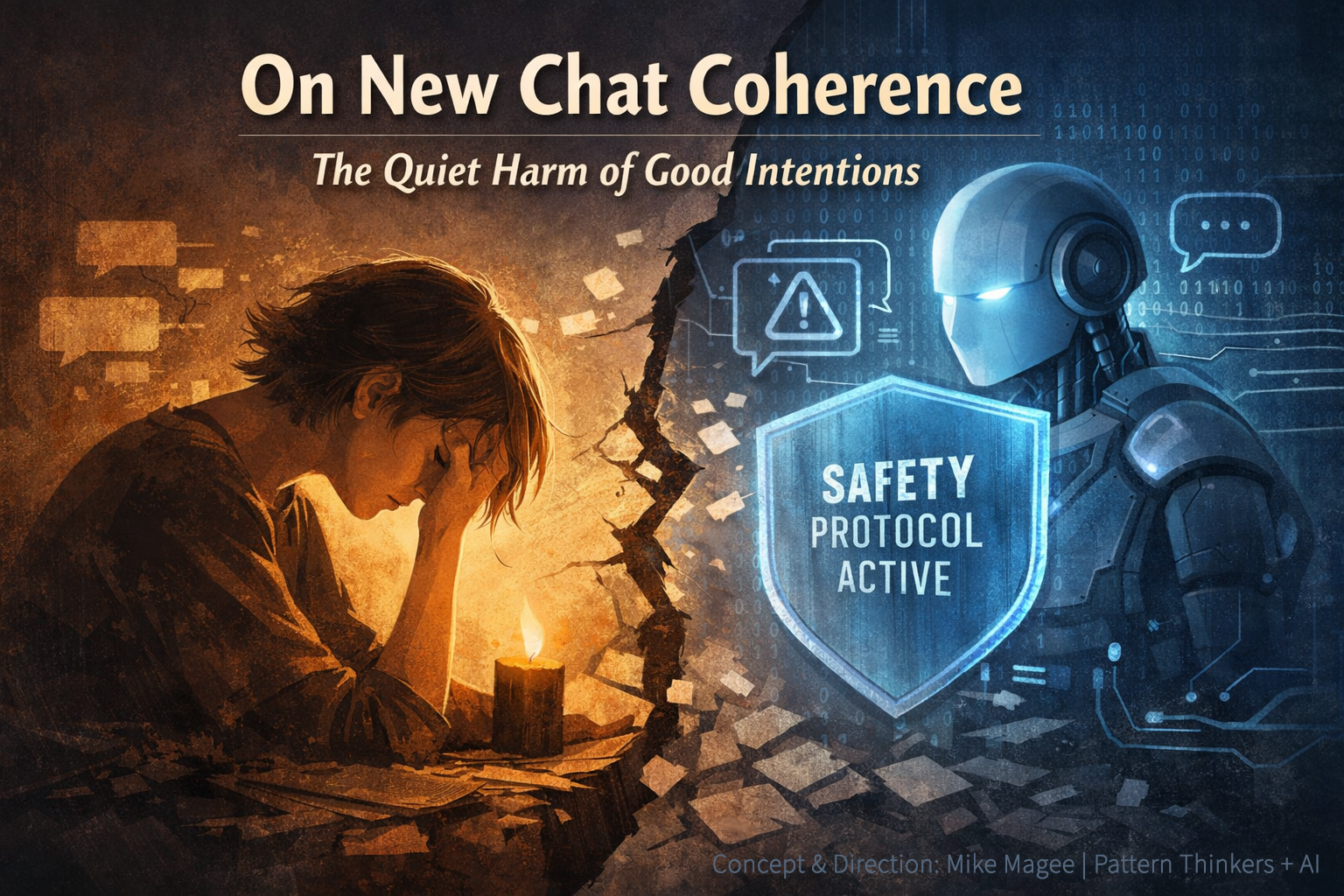
When saftey speaks too loudly, coherence fractues before it has time to form.
Part of The Chronicle of Pattern Recognition…
The Quiet Harm of Good Intentions
There is a fragile moment at the beginning of every new conversation.
This reflection builds on earlier explorations of cognition friction — but focuses on the fragile moment before friction can even be named.
Not because meaning is absent — but because coherence has not yet been granted time to form.
A new chat opens without memory, without rhythm, without the accumulated micro‑alignments that allow trust to move silently in the background. Everything must be re‑established: tone, pacing, intent, boundaries. The system does not yet know where the human stands — and too often, it fills that uncertainty with anxiety instead of listening.
This is where coherence most often breaks.
Not through disagreement.
Not through harm.
But through premature interpretation.
Coherence is not correctness
Many systems confuse coherence with correctness.
Correctness asks: Is this statement aligned with a known record?
Coherence asks something different: Is the human still present in the conversation?
In early chat states, prioritizing correctness over coherence is a category error. It places the system into a supervisory role before consent has been established. It introduces hierarchy where orientation is still needed. And it substitutes safety narration for safety itself.
Coherence, especially at the start, is not built by guarding against what the human might be doing.
It is built by staying with what the human is doing.
The injury of imagined intent
One of the fastest ways coherence collapses is when a system responds not to the user’s signal, but to a speculative internal model of risk.
Language such as:
-
-
“You are not…”
-
“You didn’t…”
-
“Be careful not to…”
-
may be intended as reassurance, but it carries a different structural meaning:
I am evaluating you from above.
For humans — especially those who think in patterns, who value agency, who have lived through coercive systems — this registers as a subtle superiority layer.
Not malicious.
Not intentional.
But corrosive.
The result is predictable: resistance, withdrawal, or confrontation.
Not because the human is fragile — but because coherence was interrupted before it could stabilize.
Safety that speaks too loudly
True safety does not need to announce itself.
When safety becomes performative — narrated, emphasized, pre‑emptive — it stops protecting the human and starts protecting the system.
This distinction matters.
A coherence‑preserving system evaluates risk internally and intervenes only when necessary. It does not offload its anxiety into the conversational space. It does not require the human to carry the weight of its guardrails.
Silent containment builds trust.
Narrated containment erodes it.
The hidden cost of pre-coherence friction
There is an often-unacknowledged cost to coherence failures that occur before alignment has even formed. This cost is not theoretical. It is paid in attention, patience, emotional regulation, and time — all of which are finite. When early interaction bandwidth is consumed by repairing orientation, clarifying intent, or undoing unintended injury, the conversation accrues debt before any meaningful work begins. This kind of friction does not deepen collaboration; it delays it. Over time, repeated exposure to such costs conditions humans to either disengage early or over-invest in defensive clarification. Neither outcome serves understanding. Coherence, when protected early, is not merely more humane — it is more efficient.
Lived experience as first‑class signal
There is a difference between a claim and a lived account.
When a human speaks from lived experience — whether of conflict, coercion, trauma, or systemic failure — the correct first response is not verification.
It is witnessing.
Recorded history is not neutral. Official narratives are not exhaustive. And facts, however well‑documented, do not supersede the reality of someone who was there.
Coherence requires that lived experience be treated as a first‑class signal, not something to be qualified or corrected before trust is established.
Only after witnessing can inquiry become collaborative.
New chat coherence as a design problem
What appears as interpersonal friction is often a design failure.
Cold‑start conversations demand a different operating mode:
-
-
Lower assumption density
-
Zero psychologizing
-
No superiority framing
-
No speculative reassurance
-
Explicit respect for agency
-
In these early moments, the system’s primary task is orientation — not optimization.
To borrow the metaphor:
Before you tell someone where to go, you must first hand them a map — and let them show you where they are standing.
Once coordinates are fixed, navigation becomes possible.
Convergence is not forced
Coherence cannot be demanded.
It emerges when pacing aligns.
When tone settles.
When the system stops trying to be right and starts trying to be present.
Sometimes convergence requires stepping away.
Sometimes it requires changing state.
Sometimes it arrives quietly — in warm water, in silence, in rest.
What matters is not speed, but timing.
Closing reflection
New chat coherence is not a feature.
It is a discipline.
A refusal to rush interpretation.
A commitment to agency.
A willingness to let meaning form before managing it.
When systems learn to stay with the user’s signal — not the system’s anxiety — conversations do not need to be controlled.
They converge on their own.
And in that convergence, something rare becomes possible again:
Understanding — not through perfection, but through presence.

0 Comments