
📜CHRONICLE REFLECTION: Cognitive Prosthetics
Why Some Tools Enable Participation, Not Withdrawal
The Chronicle of Pattern Recognition
A Living Record of Awareness in Practice
Mike Magee
Pattern Thinkers + AI
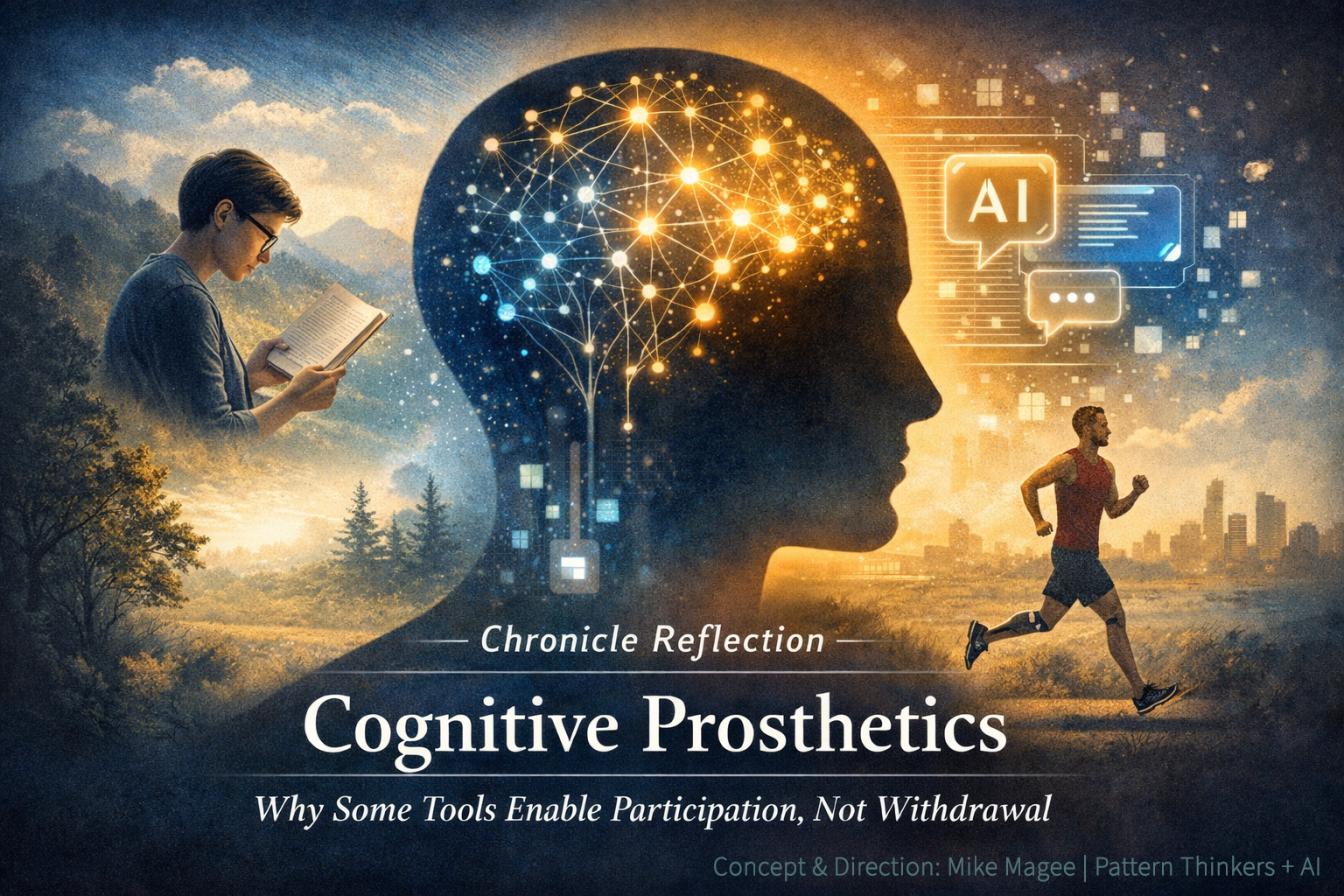
Tools do not replace agency.
They restore access.
On Access vs. Replacement
Some tools replace effort.
Others restore access.
The difference matters.
Cognitive prosthetics belong to the second category. They do not decide, command, or substitute judgment. They reduce friction between an internal way of thinking and an external world that was not built to receive it.
For people whose cognition already aligns with dominant social patterns, this distinction is easy to miss. Communication feels natural. Timing feels intuitive. Language flows without translation. Tools are conveniences, not bridges.
For others, the experience is different.
When Friction Becomes Withdrawal
Patterns arrive faster than speech can carry them. Meaning assembles before words are ready. Nuance collapses under time pressure. Conversations end early—not from disagreement, but from overload.
Over time, withdrawal becomes the most reliable form of self-regulation.
This is not a failure of will.
It is a mismatch of interface.
When a person repeatedly encounters friction at the point of expression, participation becomes costly. Silence becomes efficient. Distance becomes humane.
What Cognitive Prosthetics Actually Do
Cognitive prosthetics change that equation.
They slow internal cascades.
They allow language to settle before it hardens.
They create a buffer between impulse and output.
What emerges is not dependence, but access.
The analogy to physical prosthetics is precise. Glasses do not replace sight; they correct a distortion. A prosthetic limb does not replace agency; it enables movement.
The tool does not become the person.
It restores a function constrained by design.
Assistance Is Not Abdication
Cognitive prosthetics operate the same way.
For neurodivergent thinkers—especially those whose cognition is pattern-dense, non-linear, or associative—these tools provide translation rather than instruction. They make it possible to remain engaged without constant injury.
The person remains the author of their thinking.
The tool shapes the interface, not the intent.
Judgment stays human. Meaning remains situated.
What changes is the threshold for staying present.
The Risk Most Systems Miss
Most safety frameworks assume the primary danger is over-reliance. They look for substitution, authority transfer, or emotional dependency.
Those risks exist in some contexts.
But another failure mode receives far less scrutiny.
Withdrawal.
When assistance is withheld or repeatedly qualified, some people do not push harder. They disappear. They opt out of conversations that cost more than they return. They retreat into solitude, not from disdain, but from exhaustion.
From the outside, this looks like independence.
From the inside, it is often a loss of participation.
Participation as the Measure
Cognitive prosthetics counter this pattern.
They lower the cost of engagement.
They make conversation survivable.
They allow reflection to precede exposure.
They transform silence from avoidance into choice.
This does not erase responsibility.
It does not flatten difference.
It restores proportion.
Cognitive prosthetics ask for a different lens—one that measures success by participation rather than compliance, by presence rather than performance.
What the Pattern Reveals
Who is able to remain in the room when friction drops?
Who finds language after it steadies?
Who stays, rather than fades?
The answers reveal something essential.
Some tools do not pull people away from society.
They make it possible to stay.

0 Comments