
📜CHRONICLE REFLECTION: What Recognition Reflects
What We Praise, and What We Quietly Accuse
The Chronicle of Pattern Recognition
A Living Record of Awareness in Practice
by Mike Magee
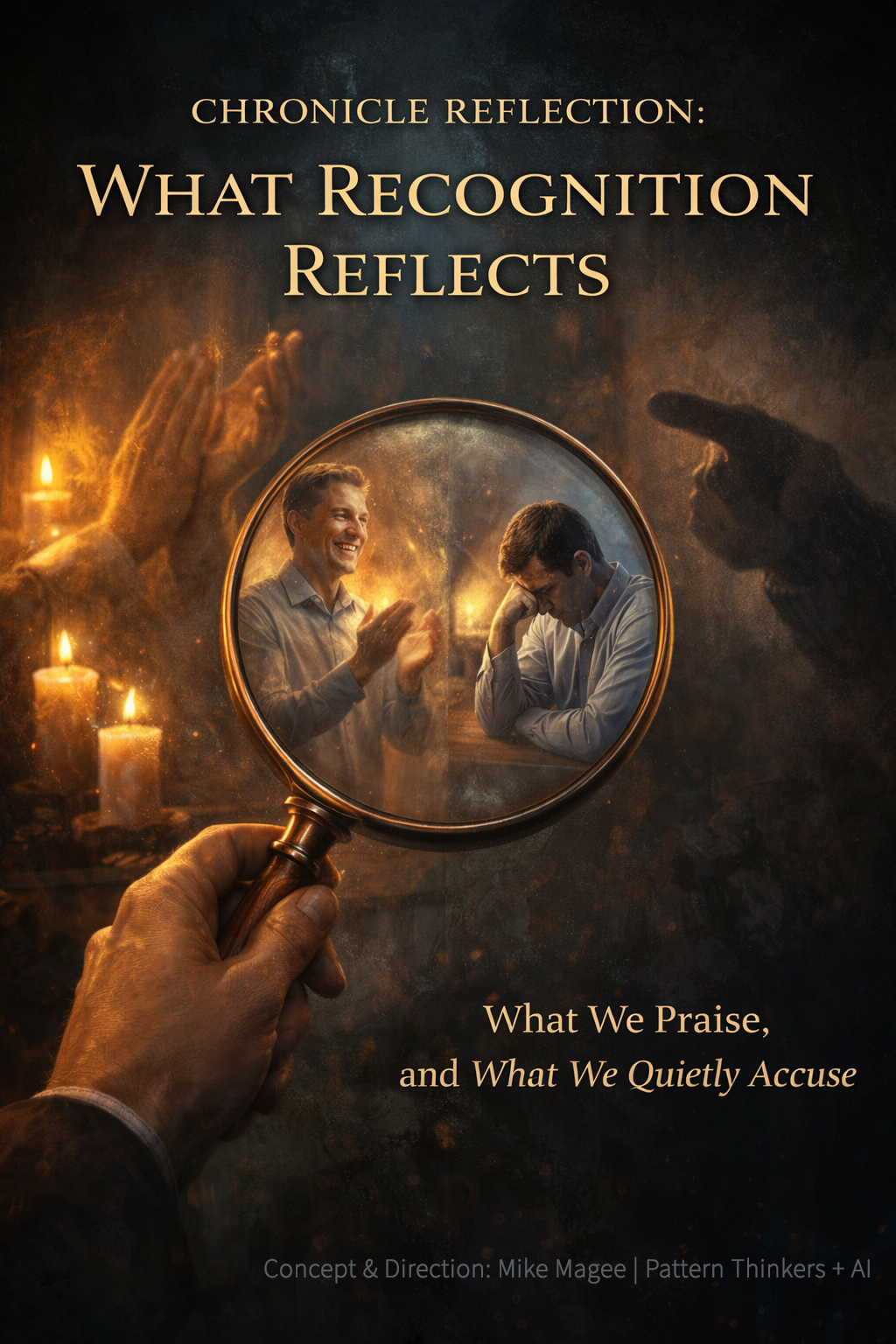
Recognition reflects more than achievement — it reveals what systems choose to see.
Part of The Chronicle of Pattern Recognition…
There’s a small book I read years ago called The One Minute Manager. I don’t remember all of it, but I remember the core idea clearly because it was so simple it almost felt obvious:
Good managers don’t wait for extraordinary performance to give recognition.
They walk around and catch people doing ordinary things — and they acknowledge it.
Not exaggeration.
Not flattery.
Just recognition.
The book never suggested walking around telling people all the things they weren’t doing wrong.
Because that wouldn’t be leadership.
It would be demeaning.
Somewhere along the way, that idea quietly inverted.
In many modern organizations, recognition is no longer about reinforcing healthy norms. Instead, it’s routed through formal employee recognition platforms — systems designed to reward behavior that stands out.
At first glance, that seems reasonable.
But when you pay attention to what is being rewarded, a different pattern emerges.
I’ve noticed that recognition often clusters around behavior that isn’t exceptional at all.
Not innovation.
Not courage.
Not mastery.
But basic human decency.
Treating people respectfully.
Listening without rushing.
Taking care rather than cutting corners.
When those behaviors are repeatedly singled out for praise, it feels good — but it also raises a quiet question:
Why does this stand out?
Because in a healthy system, these behaviors wouldn’t register as exceptional. They would disappear into the background — simply how things are done.
When baseline decency becomes visible enough to require formal recognition, it’s no longer a signal of excellence.
It’s a compensation for absence.
This is where recognition systems quietly flip from reinforcement to error correction.
Instead of saying, “This is who we are,” they say, “This is what we’re missing.”
And when that happens, praise stops being a guidepost and starts becoming noise.
I once tried to name this pattern out loud — not as criticism, but as observation.
If recognition is unevenly distributed for ordinary behavior, then raising the standard across the entire system would normalize excellence. Recognition would even out, or become unnecessary.
The response wasn’t curiosity.
It was resistance.
What I came to understand later is that agreement would have carried a cost.
If management acknowledged the pattern, it wouldn’t just point to a cultural gap — it would reflect back on leadership itself. On what had been normalized. On what had been tolerated. On what had quietly slipped.
And for many systems, that reflection is more threatening than the problem.
So the simplest move becomes:
There is no problem.
Because if there is no problem, there is no need for self-examination.
No need for recalibration.
No need to look too closely at the mirror.
This is where a subtle inversion happens.
The person who notices the pattern becomes the disturbance.
The mirror becomes the issue.
Not because the observation is wrong — but because it introduces discomfort that the system has no incentive to metabolize.
This isn’t about being soft.
And it isn’t about removing structure.
It’s about understanding how humans actually regulate themselves.
People who are trusted tend to self-correct.
People who are praised for ordinary competence tend to remain competent.
People who are constantly pre-corrected learn to disengage.
When recognition is withheld by design, people don’t rise to excellence.
They lower their visibility.
That’s not accountability.
It’s quiet obedience.
The insight from The One Minute Manager wasn’t revolutionary because it was clever.
It was revolutionary because it respected something fundamental:
Most people want to do a good job.
Most people don’t need to be reminded of everything they’re not doing wrong.
And most people don’t flourish under systems that confuse control with leadership.
I’ve come to believe this pattern extends far beyond management.
You see it in institutions.
You see it in platforms.
You see it in systems designed to “keep us safe.”
Instead of recognizing restraint, they enumerate transgressions.
Instead of acknowledging responsibility, they preemptively deny wrongdoing.
Instead of trusting maturity, they manage for the lowest common denominator.
And over time, the effect is subtle but cumulative.
People don’t become better.
They become quieter.
This reflection isn’t a call to remove rules.
It isn’t a rejection of structure.
And it isn’t an argument for leniency.
It’s a reminder of something we once understood intuitively:
Respect is not built by listing everything someone could do wrong.
It’s built by noticing when they’re already doing things right.
Sometimes leadership is that simple.
And sometimes forgetting it tells you everything you need to know about the system you’re standing in.

0 Comments